Showing posts with label patron saints. Show all posts

Tuesday, January 4, 2022

The 10th Day of Christmas

 Today is the feast day of St. Titus-- St. Paul's friend and fellow missionary. St. Paul gets a reputation for being a bit hard and austere, but in his letters to and concerning Titus, we see a solicitous and human side of the great Apostle to the Gentiles. He advises Titus, "Do not still drink water, but use a little wine for thy stomach’s sake and thy frequent infirmities." which is quite a gentle and kindly advice not only to his friend, but to those of us who are unable, for various reasons, to do bigger penances: it is perfectly acceptable to take care of the body, and keep it well. St. Paul even advises it. An even more human side of St. Paul is seen in his letter to the Corinthians, in which he says "And when I was come to Troas for the gospel of Christ, and a door was opened unto me in the Lord, I had no rest in my spirit, because I found not Titus my brother; but bidding them farewell, I went into Macedonia." The stern and austere Paul was so saddened by missing a friend whom he expected to see, that he writes about it in a letter of instruction to the community at Corinth! If that isn't the most relatable sentiment, I do not know what is!

Today is also the feast day of St. Elizabeth Ann Seton-- an American saint (born in 1774, just as the young nation was fighting for its existence.) and a convert to the Catholic faith. She was a wife, a widow, and an educator, and my mom took her as a patron saint when she started homeschooling us. On the rare occasions we went out to do something (a field trip, participation in a reading club, etc.) that required a school name, she put us down as "St. Elizabeth Ann Seton Academy". I, therefore, have a soft spot for this saint, and thought that it might be neat to highlight a carol (albeit, a Protestant one) that was written in 1778, by an American composer, William Billings. It is called Boston for unclear reasons-- it has nothing to do with that city at all, but is merely a fine old, properly Christmas song. Those who would like to read a little more about its history can check out the information below this midi rendering of the song (quite a good rendering, as far as midis go). And here it is, sung by the Boston Camerata:


Friday, December 27, 2019

I Drink You the Love of St. John

As is usual for the feast of St. John, I have been unable to unearth any songs proper to his day (even though I know they exist), aside from the Propers of the Mass for St. John, and similar liturgical chants. Which are, of course, all fine and well-- indeed, I am particularly partial to chant-- but however fine and braw those are, they do not exactly strike the ear with the sort of gladness and jollity that carols and hymns do.. So, once again, this post is sans songs in honour of the Beloved Apostle.

There is, however an extremely fabulous old custom, which I would truly love to see brought back into common practice, which I shall highlight here instead-- the blessing of wine on St John's Day. I have never seen this done, nor do I know of any Catholic church within the greater area that does it.

St. John is long associated with wine, because of a legend in which he was offered a cup of poisoned win which he blessed before drinking. The poison rose up out of the wine in the shape of a serpent. The wine blessing on his day makes the wine-- in itself a fine and cheering thing-- into a sacramental (like Holy Water, Scapulars and the Miraculous Medal), which makes it also a holy thing. It is customary, when drinking of this sacramental wine to toast each other with the words, "I drink you the love of St. John." (You should read more here.)

Since, however, it seems dreadful to not post a song at all, I have been moderately inventive, and gone looking for something that could passably be used in lieu of a St. John hymn, song or carol, and I have found this: 


I cannot tell you too much about it. It is an ancient hymn in Syriac, which is the Language spoken by our Lord. It came up in a list of ancient Christmas songs, and I have come across one other reference to it as a Christmas hymn as well, so I am fairly sure it legitimately is associated with Christmastime. There are repeated requests in the comment section for the lyrics to be posted in Syriac and English, and some way down, one poster, Joe, does give this as the translation: "glory to the Word who took a body and became a sacrifice for us, we listened to him, we saw him we touched him and we eat him..". However, since I know almost nothing about this language (save that it has one of those deep throated guttural "kh" sounds, which you can hear, within the first 30 seconds of this song, and which I find intriguing) I cannot vouch for Joe's abilities as a translator. However,since published lyrics in any language appear to be non-existent, that is the best I can do for you. I think it is a very lovely melody. 

Thursday, December 26, 2019

On the Feast of Stephen

Merry Christmas! I hope you all having a very merry, blessed and beautiful Christmastide.

For the feast of St. Stephen, I present this rather odd version of Good King Wenceslaus. Mediaeval Baebes are one of those musical groups that on paper look like they should be a good fit for my musical tastes, but I have never been entirely sure what to make of them. When they're good, they're very, very good, and when they're not, they're weird. This version of Good King Wenseslaus  may actually be straying a wee bit more into the weird than I generally prefer, but the unexpected shift of mode, with its dark, minor, and rather Middle Eastern is rather intriguing, and I like the instrumental arrangements that go with it, so I have decided to just go for it, and post a Christmas song that is a bit out of the usual for this blog:


Friday, December 6, 2019

Santa Nicholas, Oro Pro Nobis

This is a belated post for the feast of St. Nicholas, and there is not much of substance to it. I have written about this great saint before, and cannot think of anything particularly to add to it, so have settled instead for this little drawing:


I have greatly enjoyed experimenting with white-on-black art like this, as it creates a marvelously illuminated look, and it seemed a particularly good medium for creating a vaguely Christmasy image of good St. Nicholas.

I also came across this hymn, which I quite like-- being enamored of the otherworldly and.... dwarvish?..... quality of Byzantine chant. An Apolytikion is a dismissal hymn that summarises the lesson of the feast. Given the late posting, it seems quite fitting to sign of with an Apolytikion:


Saturday, January 5, 2019

Twelfth Night

I Saw Three Ships Come Sailing In, seems a good almost-Epiphany song, so that is what I am going to post today:


Today is also the feast day of St. Edward the Confessor, the last Anglo Saxon King of England and the uncle of St. Margaret of Scotland. I did spend a certain amount of the day attempting research on Anglo Saxon Christmases, to very little avail. I did, however, and most happily make a discovery. In spite of my interest in Old English language and poetry, I am only passingly familiar with Cynewulf's Crist -- here meaning that I am very aware of its importance, know that it is an epic poem on about our Lord, and (because I am me) that it is the poem containing the line Eala Earendel, Engla Beorhtast, which inspired Tolkien's story of Earendil. What I did not know is that the first part of the poem-- the Advent part, the part praising the bright light of Earendel-- are a poetic expansion of the Great O Antiphons sung by the Church during the last days leading up to Christmas. This delighted me all out of proportion. So, in order to sneak in a little Anglo Saxon, in honour of King Edward, I am presenting to you the following:


Saturday, December 29, 2018

Lordings, Listen to Our Lay

Today being the feast day of St. Thomas a Becket, the Archbishop of Canterbury, and a Norman by blood, I have, after a prodigious amount of search, found a translation of an old Anglo Norman carol to share with you. It is a bit late for our purposes, as it dates back to the 13th century, while St. Thomas lived at the end of the 12th, but it still seems rather appropriate. You can read about the carol at the incomparable Hymns and Carols of Christmas. I like that the original contained wassails at the end, and while I am both pleased and gratified to have found this carol (after having come across a mention of an early Anglo Norman carol encouraging the drinking of wine and ale, until heads do sink) I would have been even more delighted if they had managed to include the last verse. Ah well. One cannot have everything:


Friday, December 28, 2018

Salvete Flores Martyrum


One of the goals I set for myself when I do posts like the 12 days of Christmas posts, is for the songs, or poems I chose to be original-- something which I may not have heard before, and something I am pretty sure you have never heard before. Form most of the Christmas season, this can be reasonably easy, as there is a huge body of Christmas carols throughout the world, just waiting for someone to come poking along and find them. However, some of the individual feasts within the Season are harder to accommodate. The Feast of the Holy Innocents is such a feast. It isn't that there are no songs associated with it, there are. Quite a number, actually. The problem is finding recordings of them. So this year, you are getting and odd little carol about King Herod. It sets the stage for this feast, though it focuses on a miraculous affirmation of the Divinity of Christ, and cuts before Herod infamously orders the massacre of the Holy Innocents.


And, as I came across this poem in my search for a song for today, you are being treated once again to the incomparable Christina Rossetti:


Holy Innocents

 Sleep, little Baby, sleep;
The holy Angels love thee,
And guard thy bed, and keep
A blessed watch above thee.
No spirit can come near
Nor evil beast to harm thee:
Sleep, Sweet, devoid of fear
Where nothing need alarm thee.

The Love which doth not sleep,
The eternal Arms surround thee:
The Shepherd of the sheep
In perfect love hath found thee.
Sleep through the holy night,
Christ-kept from snare and sorrow,
Until thou wake to light
And love and warmth to-morrow.

Thursday, December 27, 2018

Feast of St. John


Merry Christmas! Yes, I am several days late with a Christmas post, but A.) we are within the octave of The Day, and according to the age-old tradition of the Church, every day within the octave is Christmas; and B.) I have been celebrating properly, a right good and merry series of Christmas days,which is far more important that writing about it. But, in the proper spirit of this most joyous and blessed of seasons, I say it again: Merry Christmas! May it be a time of blessing, grace and joy to all of you. And to that end, here's to a cup of cheer with friends, round the fire.

Today is the feast day of St. John the Evangelist, the disciple Christ loved, the youngest, the one to whom He gave the care of His most blessed Mother, John the Evangelist who, having taken up eagle’s wings and hastening toward higher matters, discusses the Word of God.

I don't have a carol nor a hymn to share with you today, but I found this beautiful poem by Christina Rossetti, which seems ideally suited for the day:

Earth cannot bar flame from ascending,
Hell cannot bind light from descending,
Death cannot finish life never ending.

Eagle and sun gaze at each other,
Eagle at sun, brother at Brother,
Loving in peace and joy one another.

O St. John, with chains for thy wages,
Strong thy rock where the storm-blast rages,
Rock of refuge, the Rock of Ages.

Rome hath passed with her awful voice,
Earth is passing with all her joys,
Heaven shall pass away with a noise.

So from us all follies that please us,
So from us all falsehoods that ease us,–
Only all saints abide with their Jesus.

Jesus, in love looking down hither,
Jesus, by love draw us up thither,
That we in Thee may abide together.

Friday, January 5, 2018

12th Night

Today is technically the last of the twelve days of Christmas. Epiphany is a feast in its own right, and the season of Epiphany will last until Septuagesima. In honour of the it being the last day of Christmas, you are getting this very hearty rendition of The Seven Joys of Mary, sung by Great Big Sea. It is a song I love very much... though these are not the traditional seven joys of Catholic devotion-- and I honestly have no idea how the sixth joy in the song snuck it.... that is one of the sorrows of our lady. But it is a great song, nonetheless. So without further eloquence:


Today is also the feast day of St. Edward the Confessor, the last of the Anglo Saxon kings of England. He is possibly one of the inspirations for the character of Aragorn in The Lord of the Rings - not so much because he was an exiled king, who returned to claim his throne (there are plenty of other kings who did the same) but because he was the first English king to be credited with having a healing touch-- the hands of the king are the hands of the healer. Here is an interesting article* about that medieval concept, with quotes from Shakespeare and Tolkien, so how can you go wrong?

And it being the last day of Christmas, properly speaking, and it being the feast day of an early medieval saint, you are getting one more song posted-- mostly as an excuse for me to share a bit of trivia: during this period of history, Church music was shifting from plainchant to something called organum. It was not yet the somewhat more sophisticated music form known as polyphony, and there was a strong element of improvisation that went with it-- which I find really delightful. The wikipeda entry has citation flags on it, however after poking around a bit, I think it is a fairly decent rough-and-ready explanation. And since this style seems to have been around during the days of Good King Edward, I am posting an example of it here (because we all know how much I like my chant!):


 *Once you get past the Monarchist plug at the beginning. I have sympathies for the Monarchist position-- and, indeed, I think my temperament is the sort that is naturally drawn to it-- but the few Monarchists I have met usually take themselves far too seriously, and unlike Brother Andre here, tend to treat all other forms of government as intrinsically disordered. And anyone who disagrees with them as suspect.

Tuesday, January 2, 2018

A Day Late.... Or Not?

Yesterday’s post was shorter than I wanted it to be. According to the Eastern Rite calendar, January 1st is also the feast day of St. Basil the Great, and there is a hymn in his honour that I wanted to post. I’ve heard the tune before, on a recording of Christmas music for piano, but, if I remember correctly, it had been credited as a New Year’s carol, and I had never really thought much about it. I stumbled across a group of wee Greek children singing it while looking for a New Year song that wasn’t another wassail. I really wanted to post a version of it, but I knew exactly what I wanted: something hearty, preferably with men’s voices, preferably unaccompanied (though if the music did not overwhelm the singers, I would consider it) and (a long-shot, I grant you) in English, or at least, with an English translation to go with it. I wasn’t really expecting to find something that hit all those marks, but after an hour or more of looking, I couldn’t find anything that really fit… and I was sort of appalled at the number of hammer dulcimer covers that exist of the tune! So I gave up on that idea, and decided to come back to it next year…. If I remembered.

Well, this morning, I went looking for a list of saints whose feasts are today, as sort of an inspiration for today’s post. Imagine my surprise when St. Basil’s name came up…. The same St. Basil. It turns out, Eastern Catholics celebrate the feast day on the 1st, but we Westerners celebrate it on the 2nd. This gave me a second chance to go looking… and lo and behold! I found the following cover. It is translated and re-set to its original tune by Scottish singer/songwriter, Thomas Beavitt. How is that for a happy meeting of East and West?


If you would like to know more about St. Basil’s Day customs, you should look at this website. I am intrigued that there is a tradition nearly identical with the Scottish tradition of firstfooting.


Friday, December 29, 2017

The Fifth Day of Christmas

Today is the feast day of St. Thomas a'Becket, Bishop and martyr. St. Thomas is an excellent saint for our times. Unlike many of the early martyrs, his was not a straightforward case of dying for God and/or the Faith. St. Thomas died (much like St. Thomas More after him) for a principle regarding the Faith. To whit, that the Church, being founded by God, had certain rights, upon which the state must not impinge. Furthermore, he is a wonderfully human saint, prone to ambition, love of ease, swayed by desire to retain power and friendship-- and yet, when he became Archbishop of Canterbury, at the request of his friend, Henry II, willing to renounce it all, in order to serve God fully. There was a good deal of personal cost associated with this. It eventually cost him his friendship with the King, and at long last, his life. It is important for us to remember in our increasingly secular society, in which Christian morality, philosophy and virtue are under attack (at least passively), that we are called to witness, not only to God and the Faith of God, but to truth as well. I strongly recommend you read the account of his life on Catholic Online

I thought it would be good to post a carol that dates back to the time of St. Thomas a'Becket. It took me a little while to find one that fit the bill.... Indeed, when I found one, I was quite astonished by what it was. In Latin, it is Orientis Partibus, which sounds braw, and Latinish. But according to Hymns and Carols of Christmas.... it is the earliest version of a very childish little carol, The Friendly Beasts!


I am including the English translation below, but you really ought to read the article yourself. It is has the modern lyrics, the Latin lyrics, and the following translation:

From the East the donkey came,
Stout and strong as twenty men;
Ears like wings and eyes like flame,
Striding into Bethlehem.
Heh! Sir Ass, oh heh!

Faster than the deer he leapt,
With his burden on his back;
Though all other creatures slept,
Still the ass kept on his track.
Heh! Sir Ass, oh heh!

Still he draws his heavy load,
Fed on barley and rough hay;
Pulling on along the road --
Donkey, pull our sins away!
Heh! Sir Ass, oh heh!

Wrap him now in cloth of gold;
All rejoice who see him pass;
Mirth inhabit young and old
On this feast day of the ass.
Heh! Sir Ass, oh heh!

Wednesday, December 27, 2017

The Feast of St. John the Evangelist

Poor St. John gets even shorter shrift than St. Stephen. This was not always the case. According to the Hymns and Carols of Christmas website, there are a number of songs in his honour, at least well known enough to have been collected, once upon a time. But can we find a recording of any of those songs.... not on your life.

So you get something a bit odd, with disclaimers attached. To begin with, I cannot find out anything about it. I am fairly sure it is an Orthodox, rather than an Eastern Rite hymn. It was recorded by a group called the Psalmopevtsy Ensemble (about whom, apparently, nothing is known), on a CD called The Alphabet: Psalms by Archimandrite German. An archimandrite is apparently the head of a monastery, or of several monasteries, at least, according to the Catholic Encyclopedia. I cannot find a thing about Achimandrite German, though the cover of their CD states that he died in 1682. I am guessing it is Russian Orthodox, rather than Greek, as it was recorded in the Refectory Chambers of the Resurrection Monastery of New Jerusalem, Istra, Moscow Region. Some of the sites which sell this CD give it a more complete title of  "The Orthodox Tradition Of Singing The Alphabet" which simply adds to the mystery of the whole production. Nor, for that matter, in spite of the fact that the title of this pieces is given in English: Accept Our Hymn, St. John the Theologian, can I find the words-- certainly not in English, and I don't seem to be getting anything in Russian or Greek either, though, given that both those languages are entirely outside my area of knowledge, I might have found them and not realised it.... 

Still, it is mighty beautiful, and I liked it, so you get to hear it too:


Friday, January 6, 2017

Twelfth Night


Oh come, all ye faithful........http://www.pinterest.com/annefromla/holiday-christmas/:

This post is later than I intended, as matters (both weighty and enjoyable) intervened, and I was not so efficient with my day as I meant to be. I have an Italian's priority: when I ventured out into the mad,frozen, treacherous world (we had snow, followed by rain, followed by a wee bit more snow, and then a hard freeze) to brave the crowds of  ski-crazy visitors to our fair city, I remembered basil and tomatoes, apple cider and chestnuts. I forgot the sand bags, which can be got for free, and which I should have grabbed in anticipation of yet more rain, on top of yet more snow, in a place already half-flooded from the first taste of such a mix. 

But ah well. It is the last day of the Long Christmas, and it seems good to finish off with another quote from The Christmas Chronicle, this time concerning the Magi:

The ancient "Calendar of Saints" from Cologne offers, for the year 54 AD, the following interesting account of the Magi who visited the Infant Jesus at Bethlehem: "After thy had undergone many trials and fatigues for the Gospels, the three Wise Men met at Sewa in the year of Our Lord 54, where they celebrated the feast of Christmas in common; whereupon, after the celebration of the Mass, they died."

Tradition ascribes their deaths to martyrdom. That excellent website, "Hymns and Carols of Christmas" has a good deal of information concerning the Magi in the notes for "We Three Kings." You should definitely scroll down and read it.

Lastly, this antiphon from the Christmas Mass, in the Byzantine Rite:

Your Nativity, O Christ our God, has shed the light of knowledge upon the world. Through it, those who had been star-worshipers, learned through a star to worship You, O Sun of Justice, and to recognize in You the One who rises and who comes from on high. O Lord, glory to You!

(Hat tip to Molly for the words!)

Monday, March 7, 2016

Celebrate With Me, My Friends!


Today is the Feast of St. Thomas Aquinas, also knows as The Angelic Doctor. St. Thomas possessed one of the keenest minds of his time - perhaps of any time. He wrote reams of theology and philosophy, could dissect and issue so thoroughly, that there is literally nothing left to say about it:

This is the truth.

He wrote poetry, and is responsible for much of the prayers for the Corpus Christi Mass. For years, his staggering intellect, weighty writing, and passionately pure virtue, left me rather in awe and very intimidated by him. 

Last year on his feast day, however, I discovered that one could have a bit of the Summa Theologica emailed daily, so that within a year, one would have read the whole thing. At that time, I was reading a fair bit of philosophy. Nothing terribly heavy, mind. I'd gone through most of C. S. Lewis's apologetic works - and, with allowances for inter-Christian ecumenical tendencies, very fine and clear writing they are indeed. I was dabbling with the Greeks - Socrates, Plato, and Aristotle. Aristotle was my favourite. As it turns out, he was Thomas' favourite as well - The Philosopher, is what Thomas called him. So when I was confronted with a opportunity to read the Summa in small doses, it seemed like so brilliant a plan that I signed up for it on the spot. 

I've stuck with it, too, though I'd occasionally fall behind, and slave away to catch up. Occasional, St. Thomas so beat his subject to death, that I was exhausted by it, before the subject itself was exhausted, and I would skip ahead a bit. But, for all intents and purposes, I have managed the whole thing. (Or nearly: due to a computer glitch, there were two days in which it did not come as it out, so I have two more days left of it... but almost!) And... well, there is no denying that it was a challenge. But St. Thomas, for all his weightiness of style, has a blunt and matter of fact approach to The Truth, and will not be put off by sophistry, nor muddled thinking. St. Thomas, in fact, is practical.

He can also be very literal:

This is is also the truth. 

He was also very human, however, in spite of his great virtue. He was, for example, a bookworm. There was one time in which he and a companion were travelling to Paris, where he was supposed to have dinner with the King. When the great city came in to view, the companion said, "How wonderful it must be to own that all!" To which Thomas replied, "I'd rather have that Chrysostom manuscript I can't get hold of!" I understand Thomas there.

He was also absent minded - a result of the intense mental battles against fallacy which he was constantly waging in his own head. During one of the formal dinners with King Louis of France - which he was obliged to attend - St. Thomas, rather than eating, drinking, or talking to his companions, just sat there, thinking. Conversation carried on all around him. People were enjoying themselves, and Thomas was lost in thought. Then, all at once, Thomas brought his fist down on the table with a tremendous crash, that stunned the assembly into silence, "And that will settle the Manichees!"(The King, to do him credit, merely sent for a secretary to write down Thomas' argument right then and there, in case he forgot it.) 

Furthermore, he had some of the most truly appalling handwriting I have ever laid eyes on:


Thomists everywhere should give ceaseless praise to God that St. Thomas mostly wrote by dictating to secretaries... because, that chicken scratch is impossible to read. 

In short, I have become very fond of St. Thomas Aquinas in the year that I have spent with him. He is still far too brilliant and holy for me. I feel in his presence, rather the way Sam Gamgee feels around the Elves. But his loftiness has been tempered by an appreciation for the sheer, exuberant, childlike enthusiasm with which he tackled the world. And a hearty thankfulness for the Summa. I've actually drawn on some of that reading, recently, to answer questions I didn't even realise I knew the answer too. It is satisfying. 

And on that note, I shall urge you all to read a little bit more about St. Thomas, here. And leave you with this picture, which is a bit too true:

Aw... The Angelic Doctor understands!:

St. Thomas Aquinas, pray for us.


Sunday, December 6, 2015

Gracious and Good Lord, We Bless You On This Feast of St. Nicholas....


Today is St. Nicholas Day, everyone! Happy feast day!

LOL!:

I've mentioned my fondness for St. Nicholas in this space before, and I shall not go into all that again today. Suffice it to say, St. Nicholas is a really great saint - a far more interesting character than the distant relative, Santa Claus - and one who deserves to be far better known than he is. 

My family has been celebrating St. Nicholas Day for years now. We leave out shoes, as per the custom, and St. Nicholas obliging fills them with candy and things. I usually light a candle in front of my very fine statue of the good saint (depicted in this very poor picture):


We are a very food oriented family. When a celebration is in the offing, we always start by planning what we're going to eat... and drink too, for that matter. There is always a nice dinner on St. Nicholas day. (There is a pot roast cooking at present, fragrant in a broth of rosemary and ale) We will often brew up a very hearty batch of bisschopswhijn which is perfect for the cold winter nights. It is all very festive, very fun, and thoroughly seasoned in tradition. What is not to love about it?

In celebration of the Day, here is a hymn in honour of the saint. 


This is a particularly interesting song, from a linguistic and historical point of view, being one of the earliest English language songs to be preserved with its lyrics

The words are as follows:

Sainte Nicholas, Godes druth
Timbray us faire scone hus
At thee burthe, at thee hare,
Sainte Nicholas, bring us well thare. 

With the translation:

Saint Nicholas, God's beloved,
Build for us a fine dwelling place
At time of birth, at time of death,
St. Nicholas, bring us safely there.

And on that note, may St. Nicholas bless and guide you all.


Sunday, May 17, 2015

One Doodle and Two


Yesterday was the feast day of St. Brendan the Navigator. St. Brendan was an Irish explorer monk, the patron saint of sailors, who is credited with the discovery of America in the 6th century. (I've written about it before.) Tolkien wrote a poem called The Death of St. Brendan - or, alternately, Imram, about St. Brendan's adventures. You can read the whole thing here and you really should do so. It is lovely. Many years back, I started a project involving writing the whole thing out on pale blue paper, in Tengwar, with watercolour illustrations and silver gilding all over the place. I didn't get so far, though I still have the pages I wrote out, and would like to start fresh, as I never did entirely abandon the idea. However, I have been thinking about it a good deal more than usual the last few months, because St. Brendan figures into the myth-building part of the story I am working on, and that line of Tolkien's "a cloud, a tree, a star..." has been going about my head while I struggle to write what I want to write. I ended up doing a small illustration for the poem yesterday. It started on a cheap bit of scrap paper while I was at work, and though it was meant for a draft, the sketch was better than anything I was likely to follow it up with, so it turned into the illustration. Cheap scrap paper does not lie flat once you splash watercolour on it, even if you are restrained in the splashing, so it did not photograph as well as it ought. But I was rather pleased with it. So here you are, a day late: St. Brendan the Navigator:


This other picture takes a bit of explaining. Several of my co-workers were discussing small children the other day and how small children generally want to grow up to be famous. They both agreed that they had wanted to be famous when they were little, and that seemed to clinch the matter. That is, until one of them looked at me sitting there, and amended it to, "Except Mahri. Mahri never wanted to be famous." Which was true. I wanted to be good at thing, I just didn't care who knew about it, and I said as much, aloud, to the amusement of the audience. "You just wanted to be Daredevil." one of them remarked, and I, after a stunned moment, agreed whole-heartily. The timing of this conversation was rather uncanny. My sisters and I were in the middle of watching Daredevil at the time, though I hadn't mentioned it to anyone at work, and the idea of being a sweet anonymous person during the day, and a skilled avenger at night (thus maintaining my anonymity) appealed to me strongly. So I came home a doodled a Daredevil librarian, which was gradually embellished (ha, what a word for so slight a work) with a tiny bit if watercolour and some green and brown ink. The result isn't nearly so impressive as the image in my mind, but I rather liked it when it was finished. 


And that is that. Doodles, as usual. I think I must make an effort to work at this art stuff a little more seriously than I have been. I enjoy it. It's just not my strongest suit.

Thursday, May 30, 2013

In Which I Am Bold


Today is the feast day of St. Joan of Arc. I have a special fondness for St. Joan. She was a great influence on me during my teenage years. I liked her. She was the sort of girl with whom one could easily be friends. She was devout, but passionate with it. She loved beautiful things, which gave here just a wee, charming touch of vanity. She was brought up simply, and was well-contented. If she had been left to her own devices, she would have remained in obscurity, a shepherd-girl, who loved her home and her family, and enjoyed her life amongst them. Yet, when God literally spoke to her, through His angels and saints, and revealed what His will was for her, she had the moral courage to walk away from everything she loved, and serve Him as He wanted to be served. She became her country's great hero, an almost legendary figure, but she remained herself to the end - Joan the Maid, who would have gone home to her mother, if she could. I wanted very much to be just like her. Indeed, my goal in life is still very much the same: to be contented in the life God has given me at the moment, but, if at some point, He gives me another way of life in which to serve Him better, to show the same sort of courage as St. Joan and follow Him.

I think I have mentioned before on this blog, that there were Scottish soldiers fighting in the army of Joan of Arc. One of the great number of books I intend to write, but have not gotten around to actually working on yet, is a work of historical fiction, from the viewpoint of one of those Scots, possibly a piper. (Yes, there were pipers too. Once the French had lifted the Siege of Orleans, St. Joan marched into the city, with a company of pipers.) Several years ago, however, I did write a short story as a sort of back-history to the book I intend to write. It takes place sometime after the Scots had suffered a defeat at a Rouvray, in a skirmish known as the Battle of the Herring. And after much debate within myself, and with a certain measure of trepidation, I have decided to post it here:

*********************

Hughie Stewart was drinking, though he no longer knew what, nor did he care, so long as it was strong. He had started with just a little of the rough, red wine common to that area of France, but that was weeks ago and no matter how much of it he took, it had not the strength to keep the faces of his dead comrades from coming to him in his sleep. Whatever it was he had now was a harsh, strong drink that burned his throat and belly. It was vile, and made him long for the pure uisce beatha of his own native Scotland, but it served his purpose. He drank until forgetfulness came, until the world around him blurred and spun, and sleep was deep and black and dreamless.


Occasionally during those weeks, he would come to himself, lying in some forgotten corner of a dirty inn, or in a back street, with a sickness upon him, and a head shattered by drink. Then he would look at himself with a clear, sardonic eye, and see himself plainly - and the sort of man he was rapidly becoming. At such times he would be bitterly ashamed of himself, and resolve to break from this life, but grief was more bitter still. In those moments of clarity, he would see again the faces of his clansmen lying broken by the English assault on the field of Rouvray: his older brother Dauid, who had promised their mother to keep an eye on Hugh; his cousins, Robert and Angus; Roger, his friend from boyhood, who had left a wife; brave John Stewart who had led them… He was but a very young man, and now he was alone in a foreign land, wounded in both body and spirit. He drank alone. There was an intensity in his silence that prevented all but the most gregarious from approaching him.

He could never remember just how the fight started. There were three or four Frenchmen, that much he knew. They had been loud and crowded him too closely. He remembered that they had spoken to him, and he had stirred himself to answer. He was far gone in his drink, and the world was very distant. He heard the laughter at his response, but did not know the cause of it. He only wished for them to go and leave him in peace, but they would not. They sat down beside him, pulling their chairs up close, their faces too near and terrible to his blurred vision. He tried to pull away from them, but one of them had an arm around his shoulder. They were speaking and his muddled mind was trying desperately to make sense of what they were saying. There was something about a maid, something else about a battle and herring, and the Scots, and there was mockery in the tone.

Then he was on his feet and in a rage. He remembered with a painful clarity the sound of his chair falling back with a clap upon the floor. The one who had just spoken was looking at him with a lazy, arrogant smile, and Hugh hit him full in the face with all his strength. The man went down without a sound, and his companions were on Hugh in an instant. Had he been less gone in drink, or had a single man to stand with him, he could have held them off, for he was a fierce and canny fighter. But he was ill and drunk and alone. The wound he had taken at Rouvray was barely healed and the arm he had taken it in sore and slow. The Frenchmen took him out into the street and beat him for their companion; beat him, though he fought to the last, until he was bruised and bloody and fell unconscious in the gutter.

He came to himself some little while later, slowly, and in great pain. His head hurt so that he could scarcely bear to lift it from the ground. His very eyes ached. The wound in his shoulder had reopened and he could not move the arm. He had a hundred aches and bruises. For a time he could do no more than lay still, but gradually the pain receded, and he was able to sit up, though his whole body protested, and his head hung down upon his chest. He felt sick, broken and utterly wretched. He thought of his clansmen on Rouvray, and buried his face in his hands.

When he at last felt well enough to stand, he returned again to the inn, but only long enough to retrieve his gear. The innkeeper was a kindly man, with a son nearly the age of Hugh. He returned the things, shaking his head slightly, and said, “You should not drink so much, mon ami.” Hugh looked down at the sheathed sword in his hand, then at the innkeeper’s worried frown. “I will not do so again,” he vowed, and went out.

Nor did he, but neither did he eat. He wandered to streets blindly, though now it was not the ghosts of Rouvray he fled, but those of himself, and the man he had become those last weeks. Sometimes he came to a church, and at such times he would go in, and kneel in the dark shadows at the very back. He could not pray, his mind and soul were too disquieted for that, but he knelt before the hidden God, and showed Him his sorrow, for a small space of time before that sorrow drove him to wandering again.

*********************

He did not see the line of men on horseback until they were almost upon him. The foremost rider nearly rode him down before he was able to draw his beast up short and halt his men. The man uttered an oath, and a surprisingly high, light voice called, “Baudicourt!” in rebuke. The man recollected himself, and apologized hastily, almost sheepishly. There was a laugh, and the light voice went on, “What is it you have found there, mon capitaine?”

Hugh had leapt backward at the last moment, when the noise of their riding had finally burst upon his ears. He had fallen, weak from hunger, and lay there, spent and aching from head to foot. He stared up at the riders, nearly blinded from the glare of torchlight. There was a stir amongst them and a babble of voices. A figure, somewhat smaller than the others, broke from the line and came riding forward. He saw the red light glancing off armour, the dark shadow of cape billowing in a stir of wind, then a small, pleasant face looked down at him, the eyes bright, though there were shadows beneath them. "En nom Dieu!" the light voice exclaimed.

He stared helplessly back, astonished even through his pain, that it was a young woman who was looking down at him. He remembered, distantly, the night at an inn, when he had hit a Frenchman, and been unable to fight off that man’s friends. They had spoken of something like this, had they not? A maid, he seemed to remember one of them saying, who was coming to raise the siege of Orleans. A maid who was come in answer to a prophecy, who gave prophecy herself, and those prophecies came true. He had not paid attention to those men then. He had been consumed with his own grief, and had begged them to be gone, but they would not. Now it seemed he was looking into the face of their maid as he lay in the street. He felt the blood come to his face, and got to his feet, slowly, like an old, old man, but he was a soldier and of noble blood, so when he stood at last, he looked it.

Baudicourt was frowning at Hugh. He had been inclined at first to dismiss the man in the street as a beggar, or a common drunk, but now he stood straight and tall before him, with an odd dignity that was disconcerting. “Speak sir,” he said, abruptly, but not discourteously, “What is your name?”

“Hugh Stewart, sir, of Scotland.”

Baudicourt’s men began to speak at once, for the valour of the Scottish soldiers was well know, and the defeat of them at Rouvray had been the bitter blow that led to the siege of Orleans. “Écossais, Écossais” they said, and repeated his name, for it was John Stewart who had led the Scots.

“Well then, Hugh Stewart, of Scotland, why do you wander about the street, obstructing my horses?”

Baudicourt still glowered down on him, but it was not to Baudicourt that Hugh made answer. It was to the maid at his side, who smiled sympathy at him.

“I have lost my comrades, and…” he paused, unable to explain to these fighting men, what he had not been able to explain even to himself, “I have lost my way…” he finished softly, looking away from the goodness he saw in the face of the maid. He stared at his feet.

He heard the murmur of voices again, then the maid had urged her horse forward, till she stood directly before Hugh, and he had no choice but to look up at her. She had a good face, though she was not beautiful. There was a great purity and holiness about her, that would have been daunting, but for the frank humour that he had often observed in the faces of fighting men. She was smiling, a sad little smile, and she touched his shoulder lightly.

“It is not so hard to find yourself, mon ami .” she said softly, “The good God is kind to soldiers. How long has it been since you have eaten?”

Hugh shook his head. He could not remember when he had last taken food or drink.

“Well, Hugh Stewart of Scotland,” the bit of laughter that was seldom far from her was back in her voice now, “You cannot find yourself if you become a fantôme!” She produced a coin from the wallet hung from her waist, and gave it to him, despite his protests, “ Monsieur Stewart,” she said very firmly, “You must eat! And then en nom Dieu find a priest, yes? It will do you much good”

Hugh hung his head again. Her goodness had unmanned him, and he could not speak for a moment. “If it please the maid,” he answered at last, “I shall try.”

She shook her dark, cropped head, “Non, non, monsieur, not to please me, but to please the good God.” She smiled at him again, “Do not forget: food first, Hugh Stewart! France has need of good soldiers.”

Then she gave signal to Baudicourt, and the men rode on. Hugh watched them go with out a word, the coin she had given him clutched tightly in his fist. The maid had turned once and waved to him, and he had raised his arm in return. It was the arm that had taken the wound, the one she had touched when she had spoken to him. The pain in it was gone, and the pain in his heart seemed less burdensome. He allowed himself to think of her face once more, and grinned, a slow, unaccustomed grin. If the maid really intended to raise the siege of Orleans, he had no doubt she would. What a doughty companion she must be.

He did not immediately eat as she had suggested. He found a church first and took his customary place at the back. He still could not pray, at least, not as he wished, but he looked long and fervently at the tabernacle where his Lord lay hidden. He did not know how long he knelt there, for he forgot himself during that space of time. Then he came to himself, and looked at the little coin still clenched in his fist.

He took meat at the next inn he came to; meat only, and a bit of bread. Then he took to wandering again, and it was many days before could bear to look for a priest. It requires courage to speak of sins one wants to leave hidden, even into the ear of a good God. But at last the priest came to him, as he knelt in the shadows of a wayside church – an old priest, wise in God. Hugh allowed the priest to lead him out into the sun, and when the old man asked what it was that troubled him, Hugh told him, hesitating a good deal over the story. He wanted to be honest, but was shamed by the telling. The priest listened, saying no word until it was over, and then, there was no rebuke. He simply said, “ah, poor man,” and comforted him as a father. The next day, Hugh returned to him, and was properly shriven. Then he knelt for a long time before the altar, praying not in words, but from his heart, showing the good God the sorrows he still bore, and thankful for the comfort He had been given.

*********************

The army of the Maid of France lay camped before the River Loire, near the besieged town of Orleans. Hugh made his way there, neatly uniformed and girt with his sword. The guards stopped him at the edge of the camp, but he surrendered his sword to them with his name, and asked to see the Maid, or, failing that, Baudicourt. A soldier was sent with the message and returned a short time later with a grin on his face. He spoke to the guards first, before delivering his message.

“She’s arguing battle strategy with le capitaine. By my staff! There is a woman can argue for you! You think, mon ami, that you have won the argument, and then she says, ‘in the name of God, it shall be done this way!” and all at once you see that it must be so.”

The soldier nodded at Hugh, returning the sword to him. “She says she’ll see you, if you be the same Hugh Stewart of Scotland she remembers.” He laughed at the startled expression on Hugh’s face, and led the way across the camp to tent, where the maid sat before a table strewn with maps. Baudicourt was beside her, looking irritated and amused, as he often did in the company of Jehanne of Domremey.

The Maid saw Hugh as he entered. She rose, and a bar of sunlight from the open tent-flap fell upon her white armour, and threw a halo of light about her face. She held her hands out to Hugh, and he went to her and knelt before her, his hands upon the hilt of his sword, his head bowed.

“As it please God, Hugh Stewart of Scotland pledges his sword to the cause of France and the Maid.”

She smiled the frank, boyish smile of hers, and she touched him lightly.

“Then, en nom Dieu, I am glad to have you.”

Thursday, May 16, 2013

St. Brendan the Navigator


So, back in the day when I was a wee child, I learned a bit of doggerel that ran like this, "Columbus sailed the ocean blue, in fourteen-hundred, ninety-two." And I was certain that before Columbus, not a single Old World soul had the slightest idea that there was another land across the ocean. Of course, Columbus did not discover the New World - he re-discovered it. Exactly who it was that first found the American continent is up for debate. There is a theory that the Chinese reached the New World in 1421. Indeed, there is a whole book dedicated to the idea. The Vikings, under the leadership of Leif Erickson, almost certainly reached North America in the year 1000. But if you ask the Irish, they will tell you that it was an Irish monk that got here first - sometime during the first half of the 6th century, and that monk is St. Brendan, whose feast day was today.

When Ireland was converted to Christianity by St. Patrick, the Age of Martyrs was passed, and the Faith came into small land at the far edge of the Known World, accompanied by very little in the line of persecution. Many of the Irish, on fire with the zeal of the newly converted, longed for martyrdom, but since that was denied them, they settled instead for something they termed a White Martyrdom - a complete, voluntary renunciation of the World; a continual, daily dying to one's self. There were various methods of accomplishing this. The most common, was simply to go out into the deserts (here used in the old sense of meaning uninhabited) and live in complete simplicity and poverty. The West Coast of Ireland, in particular, is dotted with tiny, dry stone, beehive structures, set up by early monks:

SOURCE

However, another method was one of exile. Some early Irish monks, such as St. Columcille, imposed exile upon themselves, and wandered about as missionaries to the Pagan tribes of Europe. In St. Brendan's case, he became a voyager. He and his monks, 'cast themselves upon the sea' in the small, leather curraghs, which are similar to the boats Irish fishermen can still be found to use. They lived monastic lives, praying, labouring, fishing, enduring the hardships of life upon the sea, and leaving their lives in the hands of God. And at one point, they set sail to the West, in search of the Blessed Realms, which they found after a voyage of seven years. Their adventures are set down in an ancient text, the Navigatio Sancti Brendani.

St. Brendan

For a long time, the Navigatio was dismissed as unreliable legend, as it is full of fantastic stories. It told of islands upon which lived giants smiths, who worked at huge forges, the fires of which shot into the sky; islands, big enough for the monks to land upon, but which were actually enormous fish; crystal pillars towering up out of the sea. For all that, it was widely accepted that a land mass of some sort existed out in the wilds of the vast Atlantic Ocean. St. Brendan's Isle showed up reguarly on maps until as late as the 16th century, and there were reported sitings of it into the late 18th century, long after the New World was well on its way to being settled by Europeans.

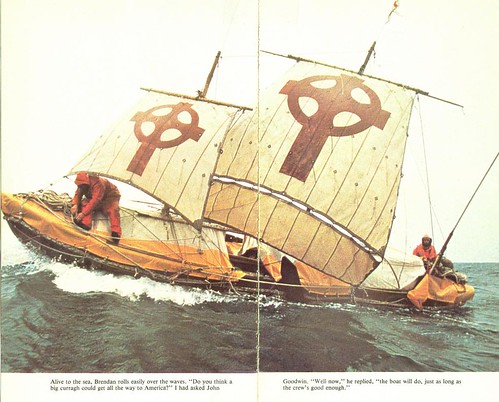
So, did St.Brendan actually discover America? There is,at present, no way to be certain of it. However, in 1976, a man named Tim Severin re-created the sort of medieval leather boat that St. Brendan would have used to make his legendary voyage.

The Brendan: A Curragh that sailed from Ireland to America
SOURCE

He and a crew of sailors were able to sail from Ireland to New Foundland in the craft, which proved, at least in theory, that is was certainly possible for a sea-faring people, as the Irish have always been, to have made the journey. He also came up with some very plausible theories to explain some of the more outlandish details recorded in the Navigatio. The easiest way to cross the Atlantic, is to stay as close as possible to known land masses, which means keeping a somewhat northerly bent to the sailing. It also means that the sailors will come very near to Iceland, which is famous - or infamous, depending on your view of the matter - for its volcanoes. The story of the giant smiths is pretty fantastic, but the descriptions of their fires could just as easily be applied to an erupting volcano. Several times during the Brendan Voyage, Severin and his crew encountered great pods of whales, whose backs broke the surface of the sea, so that the water appeared to be dotted with hundreds of islands, so perhaps the story of landing upon the back of an enormous fish is not so far-fetched as all that. And, they saw icebergs as well, which could very well be taken as pillars of crystal be men who had never seen such things before. Tim Severin wrote a book about the adventure, called simply, The Brendan Voyage which I highly recommend, as it is a great, adventuresome book, which often reads like fiction.

Finally, here is the prayers St. Brendan is to have said before he set out on his voyage:

Shall I abandon, O King of mysteries, the soft comforts of home? Shall I turn my back on my native land, and turn my face towards the sea?


Shall I put myself wholly at your mercy, without silver, without a horse, without fame, without honor? Shall I throw myself wholly upon You, without sword and shield, without food and drink, without a bed to lie on? Shall I say farewell to my beautiful land, placing myself under Your yoke?

Shall I pour out my heart to You, confessing my manifold sins and begging forgiveness, tears streaming down my cheeks? Shall I leave the prints of my knees on the sandy beach, a record of my final prayer in my native land?

Shall I then suffer every kind of wound that the sea can inflict? Shall I take my tiny boat across the wide sparkling ocean? O King of the Glorious Heaven, shall I go of my own choice upon the sea? O Christ, will You help me on the wild waves?

Thursday, March 7, 2013

Thomas Aquinas


Faithful readers of this blog know that I often post about saints' days. Sometimes it is because the saint is a particular favourite of mine, and I want other people to make friends of him too. Sometimes it is because there are really wonderful traditions associated with the celebration of the day, and I am a very traditional person. Sometimes, it is just because there is something unusual or interesting about them.

So, today is the feast day of St. Thomas Aquinas, a man, who at first glance, seems rather too much for the average person to form any opinion of at all. He was a man of prodigious intellect, a theologian and a philosopher. His densely written, intensely logical Summa Theologica was intended to be merely an introduction into theology, and yet, Thomistic scholars will devote their whole lives to the study of it. He loved God passionately and enjoyed visions and revelations from our Saviour, so that he said that all he wrote was but straw, compared to what he had seen. In short, he is quite overwhelming upon first acquaintance, which is rather a pity, he was, at heart, a simple man, who retained throughout all of his life a child-like joyfulness.

He was also practical, poetic, witty and delightfully human. Here are some useful quotes, which show the weighty intellectual in quite a different light than he is usually perceive:

*Sorrow can be alleviated by good sleep, a bath and a glass of wine.

*Beware the man of a single book.

*There is nothing on this earth more to be prized than true friendship.

*Because philosophy arises from awe, a philosopher is bound in his way to be a lover of myths and poetic fables. Poets and philosophers are alike in being big with wonder.

*A song is the exultation of the mind dwelling on eternal things, bursting forth in the voice.

*Love takes up where knowledge leaves off.


And here, as well, is a translation of a very lovely poem:... and if that doesn't sound like the writing of a congenial individual, in love with God and God's creation, I don't know what does.


Very Bread, Good Shepherd, Tend Us


Very Bread, Good Shepherd, tend us;
Jesu, of Thy love befriend us;
Thou refresh us, Thou defend us,
Thine eternal goodness send us
In the land of life to see:
Thou Who all things canst and knowest,
Who in earth such Food bestowest,
Grant us with Thy saints, though lowest,
Where the heavenly feast Thou showest,
Fellow heirs and guests to be.

Thursday, January 31, 2013

International Magicians' Day


Apparently, that is today, if this discussion site can be relied upon.. I have  no idea how long it has been celebrated, but the date was selected because it is also the feast day of St. John Bosco, who happens to be the patron saint of magicians. As a young man, John Bosco was something along the lines of a street performer. He could perform as an acrobat and a juggler, as well as doing sleight of hand and card tricks. You can find out a bit more about him here.

There are Christian and Catholic Magicians' guilds who follow in the footsteps of Don Bosco, and use magic and card tricks as a way of spreading the Faith. Here is a rather neat little video along those lines: