Showing posts with label history. Show all posts

Friday, December 31, 2021

The Old Year Now Away Has Sped--- and Good Riddance to It.

 This has been a very odd year-- one of the oddest I have ever lived through. It was most certainly eventful. There were many natural occurrences. It began with one of the warmest and driest winters on record (a great grief to those of us who require a good, long cold spell to feel human). Then there were earthquakes-- so many that I have quite lost count, and cannot even give you an estimate of the numbers we had from the first of the year through May, when they happily stopped. Despite the lack of serious winter, we had the usual war between winter and spring that always happens here, with periodic, short lived snowfalls-- usually those go through about Memorial Day, but this year, our last measurable snow fell in mid-June.... and in less than a week, we went from that, to catastrophically hot weather. At least, hot for here. We seldom get above the mid-to-upper-eighties during the summer. When we do (and I recall only a very few times in my life in which that has happened) it is a one or two day occurrence, which so colours our perception, that we talk for many years after about that "one hot summer". This year, we were at ninety and over for a whole week, and the local population was prostrate from it-- and people like myself, who cannot tolerate hot weather at all, were unspeakably miserable. It broke at last, thanks be to God and all His little helpers (to quote my estimable mother), but then came the smoke. The entire arid, crying-for-water West Coast, from Southern California, to Northern Washington, apparently went up in flames, and this summer will probably be remembered as much for the ever-present pall of smoke, as for the record heat. My lungs still ache when I think of it. There was a wildfire to the North of us, which was troubling, but not too close. And a fire to the East of us, which was a bit more alarming... and then, in mid-August, a fire to the West of us, burning uphill through the river canyons, driven by the late Summer zephyr winds that I usually welcome as a blessed reminder that summer cannot last forever, and that cooler, happier days will come again. That last fire burned far too close for comfort, and we were forced to evacuate in the middle of the night, saving what we could, and living for a week with friends. Words cannot express the unbounded joy of hearing that your very beautiful home has been spare from conflagration, nor how that joy is compounded by driving back up the mountains, and seeing the Lake in all its glory, and the town itself untouched and nearly smokeless. Nor can one adequately describe the wonder that colour-- the good, clean, natural colours of the world-- can inspire, unless one has looked at the world through smoke, and ashes for the better part of a month, and suddenly sees the world in its own, proper light again. Then finally, it was October, and there came rain, and snow, and the thirsty Earth rejoiced, and the inhabitants of wildfire-country rejoiced, and since this year was bound and determined to be a year of extremes... that was a record spell of weather, and November, not to be outdone, outdid itself with being warm and dry, and December decided that at last, this was her moment to shine, and tore open the floodgates of the skies, and snowed us in right properly. And here we stand, at the end of a wild-ride of a year, rather hoping that none of that ever happens again.

But the natural eventfulness was accompanied by Life events as well. Three weddings we had in my family this year-- one during evacuation, and one with an outdoor reception on the first, snowy day in October. I came down with shingles of all things-- a strange and fascinating disease it is.. and painful. I was painfully fascinated with the condition for a month or so, and got woefully behind on things that I was supposed to be doing... because it is quite difficult to concentrate when one is either a great big giant itch, or suffering from weird, shooting nerve-pains. The ridiculously difficult situation at work came to a head at last, resulting in a long leave that is resolving itself slowly into a more permanent solution-- much grief and anger at first, giving way to a profound relief and sense of release. God clearly took matters into His own Hands, and made a difficult decision for me (since I clearly was not going to make it myself). It was a great blessing, the way things worked out, for all of the stress and worry that the different steps entailed. So, while I cannot say that I am happy about the way things played out... the way things played out has resulted in a happier me, so all is well after all.

All and all, a memorable year-- some happy memories, some not so happy memories, some down-right miserable memories... and I am glad to have gotten through it all, but am not sure I am looking to the futures with quite the sense that "next year will be a good year"  that I have previously looked to New Years... I'm not even sure if I am looking towards the future with "surely the coming year will be better than this one.".... Indeed, I am standing on the brink of a New Year, looking out on its impassive surface, and feeling a good deal of misgiving about it. If I were a Doctor Who character, I'd no doubt poke at the New Year (unadvisedly) with a stick. Still, it is the turning of a page, and I am hoping to carry the good of this year with me into the New, to leave the bad of it behind in the burned out mess that this last year was, and perhaps... just perhaps to find a way to grow and be happy in this new place, now that so much of the burden of the last couple years has been cut away from me. That is a rather pious aspiration, and I have a limited track record of success with such hopes and wishes, but I intend this evening to have a very nice whisky, in a very nice glass, and toast to that hope. 

And here we come to the song I am posting. Novus Annus Dies Magnus. What can I tell you about it? Next to nothing. It is clearly Medieval, and it is clearly heralding a new year, and it is clearly referencing the Birth of Christ ("Lux eterna de superna venit ad nos regia". Even for those of us with a poor knowledge of Latin can find the phrase "Eternal Light", and the word "come" and the word "reign" in there... ). And there are clearly references to the Fall of Adam, and our redemption by Christ on the Cross. However, I cannot find a translation of it, nor can I find any actual history about the song. Its been recorded many times-- I have listened to a ridiculous number of them, both because I like the tune, and also because youtube vids sometimes have the equivalent of "liner notes" in the descriptions underneath, and I was hoping someone might see fit to tell me about it, only no one did. The two most notable recordings I can find of it place it in wildly different settings. One is in an album called Campus Stellae, which (as one might guess from the title) is music associated with the Santiago de Campostella pilgrimage. The other is from an album called The Feast of Fools which is full of exceedingly... odd... and possibly blasphemous titles, such as Mass of the Asses, Drunkards and Gamblers... it includes Orientis Partibus as First Vespers.... I have nothing to say about the inclusion of this tune into two such disparate albums. I shall offer that the Feast of Fools and Lord of Misrule nonsense was a Christmas/New Year phenomenon, so a song which references that... may be at home with other songs of the season? But then... how did so tainted a song get associated with the pilgrimage of Santiago de Campostella? Or did it work in reverse: pilgrimages were times of festivity and it gradually got associated with a festive season? Or is one or the other... or even both?... recordings were wrong to include it with their themes? Perhaps, if I were truly a Medievalist (and not an armature wannabe) I could offer you a better explanation. But I'm not and I can't. But it is a dandy wee song, so here it is anyway. 


Tuesday, January 5, 2021

Here's a Health to the Company

 We cannot allow the Christmas season to pass without posting a wassail can we? Well, yes, I suppose we can, but it is rather fun to see if I can uncover a new-to-me wassailing song each year. This year's entry is an American wassail-- because, apparently, wassailing hopped the Atlantic. (You can read about the history here and here. Wassailing apparently got caught up with the Lord of Misrule stuff that I have always found rather repulsive, but I still like the tradition and the songs tend to be fun and catchy. And I like them, and this is my blog, so I will continue to post them. So there.)

The wassail I am posting is called The Kentucky Wassail, though I have come across at least one version that changes Kentucky to Ohio. I am not sure how old this song actually is. It may have been collected by John Jacob Niles, a noted musicologist from Kentucky, or it may have been something that he wrote himself, based off older Appalachian song traditions. It has lyrics that are similar to ones found in both the Gloucestershire Wassail, and the Somerset Wassail, though it definitely has a bit more of that mountain music swing that is associated with American traditional music. 


Sunday, December 27, 2020

Brightest and Best of the Sons of the Morning

 I first came across this very American sounding carol last year, and liked it well. For some reason, it has been stuck in my head for the last couple weeks... Much to my surprise, it is not originally an American carol, but an English one, and it is slightly older than I would have pegged it: 1811, rather than mid 1800s. Hymns and Carols of Christmas has a write up on it, after the lyrics. 


Sunday, December 30, 2018

Sunday Within the Octave of Christmas


This Sunday is the Feast of the Holy Family. While looking for something interesting to post today, I came across this quite lovely explanation of the importance of octave commemorations. It mentions Easter in passing, but is focused on the Christmas octave. I found it inspiring, and beautiful and I hope you all do as well. 

In honour of the Holy Family, you are getting a very new song, that sounds quite old-- a song by my sister, and which I am taking this opportunity to shamelessly plug.... And to boast. She's pretty darned good, isn't she?


Friday, January 5, 2018

12th Night

Today is technically the last of the twelve days of Christmas. Epiphany is a feast in its own right, and the season of Epiphany will last until Septuagesima. In honour of the it being the last day of Christmas, you are getting this very hearty rendition of The Seven Joys of Mary, sung by Great Big Sea. It is a song I love very much... though these are not the traditional seven joys of Catholic devotion-- and I honestly have no idea how the sixth joy in the song snuck it.... that is one of the sorrows of our lady. But it is a great song, nonetheless. So without further eloquence:


Today is also the feast day of St. Edward the Confessor, the last of the Anglo Saxon kings of England. He is possibly one of the inspirations for the character of Aragorn in The Lord of the Rings - not so much because he was an exiled king, who returned to claim his throne (there are plenty of other kings who did the same) but because he was the first English king to be credited with having a healing touch-- the hands of the king are the hands of the healer. Here is an interesting article* about that medieval concept, with quotes from Shakespeare and Tolkien, so how can you go wrong?

And it being the last day of Christmas, properly speaking, and it being the feast day of an early medieval saint, you are getting one more song posted-- mostly as an excuse for me to share a bit of trivia: during this period of history, Church music was shifting from plainchant to something called organum. It was not yet the somewhat more sophisticated music form known as polyphony, and there was a strong element of improvisation that went with it-- which I find really delightful. The wikipeda entry has citation flags on it, however after poking around a bit, I think it is a fairly decent rough-and-ready explanation. And since this style seems to have been around during the days of Good King Edward, I am posting an example of it here (because we all know how much I like my chant!):


 *Once you get past the Monarchist plug at the beginning. I have sympathies for the Monarchist position-- and, indeed, I think my temperament is the sort that is naturally drawn to it-- but the few Monarchists I have met usually take themselves far too seriously, and unlike Brother Andre here, tend to treat all other forms of government as intrinsically disordered. And anyone who disagrees with them as suspect.

Friday, December 29, 2017

The Fifth Day of Christmas

Today is the feast day of St. Thomas a'Becket, Bishop and martyr. St. Thomas is an excellent saint for our times. Unlike many of the early martyrs, his was not a straightforward case of dying for God and/or the Faith. St. Thomas died (much like St. Thomas More after him) for a principle regarding the Faith. To whit, that the Church, being founded by God, had certain rights, upon which the state must not impinge. Furthermore, he is a wonderfully human saint, prone to ambition, love of ease, swayed by desire to retain power and friendship-- and yet, when he became Archbishop of Canterbury, at the request of his friend, Henry II, willing to renounce it all, in order to serve God fully. There was a good deal of personal cost associated with this. It eventually cost him his friendship with the King, and at long last, his life. It is important for us to remember in our increasingly secular society, in which Christian morality, philosophy and virtue are under attack (at least passively), that we are called to witness, not only to God and the Faith of God, but to truth as well. I strongly recommend you read the account of his life on Catholic Online

I thought it would be good to post a carol that dates back to the time of St. Thomas a'Becket. It took me a little while to find one that fit the bill.... Indeed, when I found one, I was quite astonished by what it was. In Latin, it is Orientis Partibus, which sounds braw, and Latinish. But according to Hymns and Carols of Christmas.... it is the earliest version of a very childish little carol, The Friendly Beasts!


I am including the English translation below, but you really ought to read the article yourself. It is has the modern lyrics, the Latin lyrics, and the following translation:

From the East the donkey came,
Stout and strong as twenty men;
Ears like wings and eyes like flame,
Striding into Bethlehem.
Heh! Sir Ass, oh heh!

Faster than the deer he leapt,
With his burden on his back;
Though all other creatures slept,
Still the ass kept on his track.
Heh! Sir Ass, oh heh!

Still he draws his heavy load,
Fed on barley and rough hay;
Pulling on along the road --
Donkey, pull our sins away!
Heh! Sir Ass, oh heh!

Wrap him now in cloth of gold;
All rejoice who see him pass;
Mirth inhabit young and old
On this feast day of the ass.
Heh! Sir Ass, oh heh!

Friday, January 6, 2017

Twelfth Night


Oh come, all ye faithful........http://www.pinterest.com/annefromla/holiday-christmas/:

This post is later than I intended, as matters (both weighty and enjoyable) intervened, and I was not so efficient with my day as I meant to be. I have an Italian's priority: when I ventured out into the mad,frozen, treacherous world (we had snow, followed by rain, followed by a wee bit more snow, and then a hard freeze) to brave the crowds of  ski-crazy visitors to our fair city, I remembered basil and tomatoes, apple cider and chestnuts. I forgot the sand bags, which can be got for free, and which I should have grabbed in anticipation of yet more rain, on top of yet more snow, in a place already half-flooded from the first taste of such a mix. 

But ah well. It is the last day of the Long Christmas, and it seems good to finish off with another quote from The Christmas Chronicle, this time concerning the Magi:

The ancient "Calendar of Saints" from Cologne offers, for the year 54 AD, the following interesting account of the Magi who visited the Infant Jesus at Bethlehem: "After thy had undergone many trials and fatigues for the Gospels, the three Wise Men met at Sewa in the year of Our Lord 54, where they celebrated the feast of Christmas in common; whereupon, after the celebration of the Mass, they died."

Tradition ascribes their deaths to martyrdom. That excellent website, "Hymns and Carols of Christmas" has a good deal of information concerning the Magi in the notes for "We Three Kings." You should definitely scroll down and read it.

Lastly, this antiphon from the Christmas Mass, in the Byzantine Rite:

Your Nativity, O Christ our God, has shed the light of knowledge upon the world. Through it, those who had been star-worshipers, learned through a star to worship You, O Sun of Justice, and to recognize in You the One who rises and who comes from on high. O Lord, glory to You!

(Hat tip to Molly for the words!)

Tuesday, January 3, 2017

A Christmas Chronicle


I very seldom buy things on a whim. Generally, if I am spending money on something, it is because I need it, or (after a good deal of thought) have decided that I would like to own the thing. Books are one of the few exceptions to this - especially of they are selling for a good price. A Christmas Chronicle by Aloysius Horn was one such impulse buy. It was for sale for $7.00 and I figured it was worth that to have some Christmas reading. It was an excellent investment - a rather delightful mishmash of legends, traditions, and historical tidbits about the celebration of Christmas, from the early days of Christendom, to fairly modern times. They are all short little articles - seldom more than a page, often merely a few paragraphs, but they make for fascinating reading. One of the little stories concerned a certain Saint Romanus the Melodist. (First of all - the Melodist?!? How cool a title is that? How can you not like Saint Romanus right off, with that title attached to the end of his name?) I shall give the story in full: 

To the last part of the 5th century and the first part of the 6th belongs St. Romanus the Melodist, who has been called the greatest of the Greek hymn writrs. 80 of his hymns have survived to our day. He was a Syrian Jew who when quite young, converted to the Christian faith. Later, he became a decon in the church of Beirut, and during the reign of  Emperor Anastasius I (491-518) he moved to Constantinople. It was here on Christmas Eve that Our Lady appeared to St. Romanus in his sleep and gave him a roll of paper, saying, "Take this paper and eat it." From what the saint could later recall, it seemed to him that he did what h had been directed to do. Then he awoke and in great exaltation of spirit went to the Church of the All-Holy Mother of God to assist in the Christmas Liturgy. When the Gospel-book was about to be carried solemnly into the sanctuary, he went up into the deacon's ambo or pulpit and extemporaneously recited his new Christmas hymn:


This hymn, said to be the first of its kind, is still sung in the Christmas Offices of the Byzantine rite, and until the 12th century, it was solemnly sung on this festival at the banquet in the imperial palace by the combined choirs of the greatest churches in Constantinople, Santa Sophia and the Holy Apostles.

I can only imagine how incredible that must have sounded, and what a beautiful tradition that was. There is something delightful about hearing a song of such antiquity, composed as it was, in a fever of inspiration, and with such a tradition associated with it, and knowing that it is still sung at Christmas Mass.

Wednesday, December 28, 2016

Childermas


"Then was fulfilled that which was spoken by Jeremias the prophet, saying: A voice in Rama was heard, lamentation and great mourning: Rachel bewailing her children, and would not be comforted, because they are not." From the Gospel of St. Matthew, read on the Feast of the Holy Innocents.

The Feast of the Holy Innocents has been celebrated since at least the 5th Century. There are other martyr's feasts during the 12 days of Christmas, of course, but this particular feast has always seemed to be to be particularly sorrowful. It is not on account of the little martyrs - they went to Heaven, to sit beside the Christ Child, giving their own lives that He might live to give His. No, it is on account of the quoted prophecy, "Rachel bewailing her children and would not be comforted, because they are not." The poor mothers. There cannot be many phrase containing so much grief and heartbreak in so few words. Indeed, in Rome, it was originally kept as a day of fasting in penance, and the Alleluia and the Glory are not sung during the Mass - the only day during Christmas when this occurs. 

However, a number of cheerful and even mad-capped traditions eventually became associated with the day - some of which have continued into modern times. A very good account of them may be found here. At the very bottom of the page there is also the fascinating reminder that the Novena to the Magi starts today. I had no idea that there was such a novena! I think I shall say it, with all do solemnity. 

Originally, I had rather wanted to post something new as far as songs go - but the Coventry Carol is the only carol I have come across for this day, which does make sense. I cannot decide which version I like better, so you are getting one by John Denver, because he's one of those classy old singers who doesn't feel as if he needs to torture the tune to make it "his". He just sings it, and it is refreshing. You are also getting it in Aramaic, because.... why not? It seemed fitting. 


Friday, April 24, 2015

This is the Moment!


I had to write a poem on 'moment' today. 

I also had to attend a staff meeting today. All library staff for the entire county had to gather themselves together and discuss librarianish things. We had to wear tags (I didn't. I am not a parcel and I do not believe anyone has a right to my name.) that contained our names, a book cover and a coloured border. For the first half of the meeting we sat at a table that matched the colour that border, so that we would be sitting with totally random people. For the second half, we had to sit at a table that matched the book cover, and a completely different set of random people. We had to participate. I have a low threshold of toleration for group activities. So I came home and wrote this:

For just a moment
You captured my attention
I caught your fire.

Gone is the moment
I am bored to distraction.
Have done. Cease fire.

However, today is also the anniversary of the Easter Rebellion, which began on Easter Monday, 1916. The Irish Volunteers took over various key locations in Dublin, with the General  Post Office for their headquarters. Their leader, a poet named Paidraic Pearse, read out the Proclamation of Independence from the steps of the building, though few people paid much attention. For all that, it was a pivotal event in Irish history - an odd, tiny, gallant little uprising that lasted less than a week; but the influence it had was enormous. So I wrote a short little moment poem for that too:

You stand - 
     Brave as joy
     And soldier-tall
You speak - 
     To a Nation
     And none at all
Just a moment - 
     Scarce of notice
     Few to mark
But Ireland - 
     Flames to Freedom
     At that spark.

So there. A comic poem, and one that is a bit more on the serious side. And that is better than I expected to do after a day like today. Five days left.... God help us!  


A Wee, Bitty History Lesson


It was, I'll admit, only a matter of time before I composed a poem in Scots - or at least, imitation Scots. I've always rather enjoyed writing in it. There is something very satisfying in the sturdy old words, and the way they change the tempo of the writing. I am surprised I managed to get so far before succumbing to the temptation.

But today's prompt was "history" - which is another one of those prompts that is almost too much prompt. For a while, I considered writing something both comic and heroic about Mad Jack Churchill, because, let's face it, there is great scope for poetry in a man who takes out German sentries with arrows, and used a basket-hilted claymore on D-Day. But it just wasn't clicking for me. So I cast my mind about my mental library of historical trivia (I refuse to refer to it is a mind palace.) and dug up a story from Scottish history - the story of how Lady Maxwell of Nithsdale smuggled her husband out of the Tower of London on the eve of his execution. It is proper ballad material, and I have attempted a Scottish ballad of it. I have also taken the balladeer's prerogative of heightening the drama. I have Lady Maxwell rescuing her husband all on her own, but in reality, she had her faithful lady's maid and two friends to help with the proceedings. However, the bit at the end: King George really did say something quite like that about her - that she had given him more trouble  than any woman in Christendom.


When Jamie's Cause was lost at Preston,
King Geordie's men had put us doon,
They captured gallant Willie Maxwell,
An sent the laird tae London toon.

Nae trail for Laird Willie bold
But condemnéd oot o haund
Tae the gallaws an the noose
Far frae his ain dear Scottish laund.

When his Lady heard the news,
Nae tear shed she, but saddled her steed
An straight awa tae London toon
She rade wi muckle haste an speed.

An when she came intae the toon,
She gaed at aince to King Geordie,
An begged that he would gie a pardon
Tae her ain dear laird, Willie.

But mercy he swore he wouldna gie
An the Lady drove awa - 
Willie Maxwell was like tae hang
There seemed tae be nae hope at a.

But Lady Maxwell was brave an canty,
At aince began tae plot an plan
How tae rescue Willie bold
An get him safe oot o' England.

She bribed the guards wi siller bricht
An wine, that she micht Willie see
She told him a her desperate plan,
Tae get him oot and set him free.

The nicht afore he was tae die,
Lady Maxwell gaed tae Willie's room
Wi a great red riding cloak
An ladies' claes, tae put him on.

A muckle mon was Willie Maxwell,
But he wept sae like a maid in wae
An his beard hidden by a claith,
The guards, for pity, let him gae

She got him oot o London Tower,
An got him doon unto the sea
An tae a ship that lay at anchor
An was bound for Italy

When that he had heard the news,
King Geordie, he did rant and rave,
Said the Lady had caused mair trouble
Than a hunner-thoosand aither knaves.

Lady Maxwell's nae at hame,
She has gaed far ower the sea
An she bides in Roma fair,
Will her gallant Laird Willie.

And I shall close with this link to Lady Maxwell's very matter of fact account of the proceedings. It is well worth the read. 


Sunday, December 29, 2013

Scottish Christmas


Well, it is very like me to propose to post daily, and then to become too busy to follow through with it. So today, to sort of catch  up a wee, I am posting two songs - Scottish carols, both of them, one translated from the Gaelic, and one in Scots.

By now, it should come as no surprise to anyone, that I am terribly fond of Christmas - and of history, and traditions and folk-customs - all of which interests come together so beautifully at this time of year, that I tend to spend rather a lot of time in delighted research. Some Christmas traditions are practically universal - the appearance of the St. Nicholas/Father Christmas figure for example - others are peculiar to certain nations - such as the Irish practice of placing a lighted candle in the window to guide the Holy Family to shelter, should they be in need of it. I find it all tremendously interesting. 

Scotland is sort of the odd man out as far as Christmas traditions go. A cursory search on the matter will provide you with the rather sad information that Christmas as a national holiday is a surprisingly recent development in that country; that Christmas was pretty much treated as an ordinary day until about the 50's; that it was the New Year's celebrations that people really observed. It takes a bit of digging to find out that this is only true as far as it goes. Before the Reformation, Scotland marked Christmastide with as much ceremony and celebration as the rest of Europe did. Then John Knox showed up, and while later came Cromwell and the Covenanters, and for a time the celebration of Christmas was against the law throughout all the United Kingdom. However, there always were little groups of people who continued to keep Christmas anyway - in secret, but as fully and as joyfully as could be managed. Eventually, the law was repealed, and in England, the celebration of it was observed with renewed enthusiasm.

That was not the case in Scotland, however. New Year's Day was observed, but the only people who celebrated Christmas, for the longest time, were the Catholics, and some of the more 'papish' sort of Protestant denominations. It is hard to find out too much more about it. The impression one gets is that it was what we would now term a 'fringe' phenomenon. However, I found this very lovely Christmas card from the Great War, from the Cameron Highlanders, so it can't have been all so small as all that:

From the collection of Rev. William White Anderson,
St. Cuthbert's, Edinburgh
And both the carols I am posting are from the time in which Christmas was officially not celebrated. The first, The Christ Child Lullaby was originally written in Gaelic during the 19th century and sung during Midnight Mass in the Outer Hebrides. The version I first heard was sung by The Boys of the Lough, and had some really great bass harmonies going for it, but alack and alas, that version is all but impossible to find in any form whatsoever. This is quite nice, though, so you are getting this version instead:


Balulalow, is quite an old carol by comparison. It was translated from German into Scots by the Wedderburn brothers during the 16th century, which puts it squarely during the Reformation. I only heard this song for the first time a few years back, and was immensely taken with it:


Sunday, October 27, 2013

I Got A Kiss o' the King's Hand....


Today is the feast day of Christ the King. It is a fairly new feast within the liturgical calender, having been instituted in 1925, but Jesus Christ has been honoured as King by all Christians since the very earliest days of the Church. It is, I think, a particularly beautiful and appropriate feast for our times, when temporal rulers fall so short of the standard. It is good to remember that we serve a King, Who genuinely loves and cares for His people. Here is an old picture I came up with a few years back to mark the day:


The title of the post comes from an old piobaireachd, A Kiss of the King's Hand. I had originally intended to post something particular to the day, but most of the hymns I came across featured organs and enthusiastic congregational singing. Now, mind you, when you hear the organ live, and you are part of the enthusiastic congregation, that is a grand sound indeed. However, youtube videos of the same tend to lack a certain something, so I am posting the piobaireachd instead.


The story behind the tune, is that a piper in the army or Charles II played for the king, who was so pleased with the music, that he commended the piper, and allowed him to kiss his hand. The piper wrote this tune to commemorate the event. Here are the words that go to it - and this is what always pops into my head each Sunday after Holy Communion:

Thuair mi Pòg s’ Pòg s’ Pòg
 ga’n d’thuair mi Pòg o’ Laimh an Righ…
 cha’d chur seid a n Croicion Caorach
a thuair an turram a thuair mi.
I have had a kiss, a kiss, a kiss,
I have had a kiss of the king’s hand:--
 No one who blew in a sheep’s skin,
 Has received such honour as I have

As a side note: I am not sure how widely spread the belief was, but there was a period, at least, in Scotland, when it was believed that the hands of the King were blessed, since they ruled with authority coming from God. Amongst other things, it was believed that the hands of the King were the hands of a healer. Readers of The Lord of the Rings will appreciate the historical connection.


Thursday, August 22, 2013

Disney and the War


Amy over at Old Fashioned Girl, is doing a neat Disney Tag, and she tagged me. Unfortunately, I have three tags already, which are spinning their wheels, waiting for me to get a fire lit under me and do them, and I am already feeling a trifle guilty about them, so I am not actually going to do the Disney Tag, as she set it up. However, it seems rather rotten to let it go by completely unnoticed, so I am going to share a bit of trivia instead.

During WWII, Walt Disney and Company designed military insignia for Allied Troops. They designed over 1200 different insignia, which would end up featuring nearly every one of their cartoon characters. The designs were immensely popular,and were often adapted for 'nose art' on planes and military vehicles. Two of their best known designs were for the Flying Tigers - the American Volunteer Group who fought with the Chinese against Japan: 


Eagle Squadron - a group of American pilots who flew with the RAF:


Eagle_Squadrons.jpg
picture from usmilitaryforum.com

The designs were quite diverse and humourous. They could be quite clever and sometimes rather whimsical:

6605 USAF Hospital Emblem
Picture from Air Force Historical Research Agency


Donald Duck was a particular favourite with the troops:


USS Reliable cb
Picture from USNI News


World War II Military Insignia.
Picture from The Comic Journal


Picture from @ issue


There is apparently a whole book on the subject, Disney Dons Dogtags, which is, unfortunately, out of print, and rather dear to own. There are a couple websites which tell a bit more about it here and here; and this blog has lots of pictures, so you should look at it too. 


Thursday, May 16, 2013

St. Brendan the Navigator


So, back in the day when I was a wee child, I learned a bit of doggerel that ran like this, "Columbus sailed the ocean blue, in fourteen-hundred, ninety-two." And I was certain that before Columbus, not a single Old World soul had the slightest idea that there was another land across the ocean. Of course, Columbus did not discover the New World - he re-discovered it. Exactly who it was that first found the American continent is up for debate. There is a theory that the Chinese reached the New World in 1421. Indeed, there is a whole book dedicated to the idea. The Vikings, under the leadership of Leif Erickson, almost certainly reached North America in the year 1000. But if you ask the Irish, they will tell you that it was an Irish monk that got here first - sometime during the first half of the 6th century, and that monk is St. Brendan, whose feast day was today.

When Ireland was converted to Christianity by St. Patrick, the Age of Martyrs was passed, and the Faith came into small land at the far edge of the Known World, accompanied by very little in the line of persecution. Many of the Irish, on fire with the zeal of the newly converted, longed for martyrdom, but since that was denied them, they settled instead for something they termed a White Martyrdom - a complete, voluntary renunciation of the World; a continual, daily dying to one's self. There were various methods of accomplishing this. The most common, was simply to go out into the deserts (here used in the old sense of meaning uninhabited) and live in complete simplicity and poverty. The West Coast of Ireland, in particular, is dotted with tiny, dry stone, beehive structures, set up by early monks:

SOURCE

However, another method was one of exile. Some early Irish monks, such as St. Columcille, imposed exile upon themselves, and wandered about as missionaries to the Pagan tribes of Europe. In St. Brendan's case, he became a voyager. He and his monks, 'cast themselves upon the sea' in the small, leather curraghs, which are similar to the boats Irish fishermen can still be found to use. They lived monastic lives, praying, labouring, fishing, enduring the hardships of life upon the sea, and leaving their lives in the hands of God. And at one point, they set sail to the West, in search of the Blessed Realms, which they found after a voyage of seven years. Their adventures are set down in an ancient text, the Navigatio Sancti Brendani.

St. Brendan

For a long time, the Navigatio was dismissed as unreliable legend, as it is full of fantastic stories. It told of islands upon which lived giants smiths, who worked at huge forges, the fires of which shot into the sky; islands, big enough for the monks to land upon, but which were actually enormous fish; crystal pillars towering up out of the sea. For all that, it was widely accepted that a land mass of some sort existed out in the wilds of the vast Atlantic Ocean. St. Brendan's Isle showed up reguarly on maps until as late as the 16th century, and there were reported sitings of it into the late 18th century, long after the New World was well on its way to being settled by Europeans.

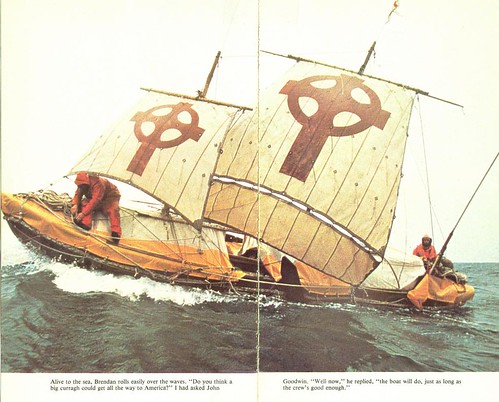
So, did St.Brendan actually discover America? There is,at present, no way to be certain of it. However, in 1976, a man named Tim Severin re-created the sort of medieval leather boat that St. Brendan would have used to make his legendary voyage.

The Brendan: A Curragh that sailed from Ireland to America
SOURCE

He and a crew of sailors were able to sail from Ireland to New Foundland in the craft, which proved, at least in theory, that is was certainly possible for a sea-faring people, as the Irish have always been, to have made the journey. He also came up with some very plausible theories to explain some of the more outlandish details recorded in the Navigatio. The easiest way to cross the Atlantic, is to stay as close as possible to known land masses, which means keeping a somewhat northerly bent to the sailing. It also means that the sailors will come very near to Iceland, which is famous - or infamous, depending on your view of the matter - for its volcanoes. The story of the giant smiths is pretty fantastic, but the descriptions of their fires could just as easily be applied to an erupting volcano. Several times during the Brendan Voyage, Severin and his crew encountered great pods of whales, whose backs broke the surface of the sea, so that the water appeared to be dotted with hundreds of islands, so perhaps the story of landing upon the back of an enormous fish is not so far-fetched as all that. And, they saw icebergs as well, which could very well be taken as pillars of crystal be men who had never seen such things before. Tim Severin wrote a book about the adventure, called simply, The Brendan Voyage which I highly recommend, as it is a great, adventuresome book, which often reads like fiction.

Finally, here is the prayers St. Brendan is to have said before he set out on his voyage:

Shall I abandon, O King of mysteries, the soft comforts of home? Shall I turn my back on my native land, and turn my face towards the sea?


Shall I put myself wholly at your mercy, without silver, without a horse, without fame, without honor? Shall I throw myself wholly upon You, without sword and shield, without food and drink, without a bed to lie on? Shall I say farewell to my beautiful land, placing myself under Your yoke?

Shall I pour out my heart to You, confessing my manifold sins and begging forgiveness, tears streaming down my cheeks? Shall I leave the prints of my knees on the sandy beach, a record of my final prayer in my native land?

Shall I then suffer every kind of wound that the sea can inflict? Shall I take my tiny boat across the wide sparkling ocean? O King of the Glorious Heaven, shall I go of my own choice upon the sea? O Christ, will You help me on the wild waves?

Thursday, December 6, 2012

St. Nicholas Day.


Happy feast day to one and all! If any of you are looking for a reason to eat chocolate, or sugar cookies, or drink hot cider, or perhaps even mulled wine - if you dwell in a cold enough climate - then look no farther. Today is the feast day of St. Nicholas, and all the aforementioned goodies are traditionally partaken of on this day.

I have mentioned before on this blog, that I have a special affection for St. Nicholas. I like saints will a lot of character, and St. Nicholas was certainly that. What I particularly like about him, is that he is a complex, very human saint. I suppose the majority of the saints must be, but it comes through with particular clarity where St. Nicholas is concerned. He showed remarkable holiness from a young age. He endured imprisonment and torture for his Faith during the persecution of Diocletian. He was renowned as a wonder-working in his own lifetime. He performed great acts of kindness and charity to the poor and suffering. He was, in short, a very good, kind, holy man, who was much loved during his life time. However, he was also a staunch defender of truth and the right, who had a very low tolerance for falsehood. He also had a temper, as the story of St. Nicholas at the Council of Nicea shows.

It is a common misconception that that goodness and holiness are rather passive and boring. Nothing could be further from the case, as anyone who has ever tried to be truly good will tell you. There is nothing passive at all in performing good works, in praying when one would rather not, in staying true to a moral code, when it would be much easier to compromise, in putting God and others before yourself.  Goodness, and holiness are intensely active. Like soldiers locked in furious battle, one must give all and stand firm, for if any ground is given, it will lead to a route. The life of St. Nicholas is a perfect example of holiness that was anything but boring. He was a man who was fiercely good, and it was his uncompromising holiness that led to his legendary sympathy and goodness to other.

St. Nicholas is one of the most popular saints in the history of the Church. His feast day is celebrated all over the world. Here is a Slavonic carol in honour of him. (Listen past the English translation at the beginning. It is catchy.)


And here is my all time favourite Santa Claus picture, partly because it us just so darn Christmasy and cosy, but mostly because his study is absolutely packed with all sorts of bric a brac alluding to the life of St. Nicholas, and his role as gift-giver in various cultures around the world. I would love to poke around that room!

Saturday, November 3, 2012

All Hail November


Eeeeek!!!! I am missing it! We are smack dab in the middle of Sherlock Holmes Weekend! Who knew, eh? According to Brownielock's handy site, Sherlock Holmes Weekend this year, runs from November 2nd to November 4th. I find this very exciting. I must take time out of my busy life life and read a Sherlock Holmes mystery. Or watch Basil Rathbone portray the famous detective. Or maybe even watch the second season of Sherlock. Oh, the possibilities!


November is also National Novel Writing Month, and I am writing a novel. Well, I am sort of writing a novel. I started bravely, and for one day, all was good. Then I had a devastating attack of writers' block, and ended up tossing out all of the work from the first day, and starting over from scratch. So now I am behind and having to write madly to get myself back on track for finishing by the end of November. At present, by handy word counter is informing me that I shall not finish until January. This is alarming. I need to get a move on.

However, before I go, Bella tagged me a post or two ago, and I have not had a chance to respond to her properly. Since I do not know when I am going to be able to write a decent post again, I am going to take care of the tag right now. Here we go:

Eleven Random Facts:

1.) According to the Urban Dictionary, the word twee has three meanings:
       1.) Something sweet, almost to the point of being sickeningly so.
      2.) To be obnoxiously sweet or quaint.
     3.) The sound a sparrow makes the moment it dies.
The first two definitions are obviously connected, but I have no idea where the last one came from. I now want desperately to write a sparrow's death scene into a story, so that I have a chance of using that word.
2.) I am wildly fond of Mumford and Sons' new CD.
3.) I am also wildly fond of piobaireachd.
4.) I can pronounce the word piobaireachd.
5.) I can sing the Cinderelly song the mice sing in Disney's Cinderella... and sound just like the mice do.
6.) Water does not boil at 212 degrees Fahrenheit if you live it 6000 feet. It boils at 201 degrees. So there.
7.) The United States Marine Corps has its own official tartan and pipe band.
8.) There was a piper at the battle of the Alamo.
9.) In the first draft of the Fellowship of the Ring, Strider was not a Ranger. He was a hobbit named Trotters.
10.) There is no good response when a homeless man informs you that he is going down to the lake to get a free manicure.
11.) I really must get back to my novel.

And Now For Bella's Questions:

1.) Do you like musicals?
I like Gilbert and Sullivan.

2.)What is your favourite musical?
The Pirates of Penzance.

3.) If you could step into a book for a single day, which one would it be?
It is a toss up. The Lord of the Rings is the one that comes to mind first. However, I would dearly love to be on the run with Alan Breck Stewart, so Kidnapped is giving that a run for its money.

4.)Do you know what a "Silver Tongue" is?
Here's one:

5.) How does this quote end? "There is evil there...."


6.)Do you like having your picture taken?
No. Nor do I like taking pictures.

7.) Do you like cold or warm weather better.
 Cold weather. Bring on the cardigans and kilted skirts!

8.)What is your favourite colour?
 Grey

9.) Do you know how a war can be passed down for generations but only last 7 days?
 Um... does this have anything to do with the Campbells and the MacDonalds?

10.)Who are three of your favourite authors?
G. K. Chesterton, Patricia McKillip, Robert Louis Stevenson, but not in that order.

11.) Do you know what a jean jumper is?
I do my best not to.

Tuesday, September 11, 2012

On This Day In History...


in 1297, the army of the great Scottish patriot, William Wallace, defeated the English at the Bridge of Stirling. It was a decisive victory, which went a long way to cement Scottish resistance against the English invaders. A good, brief account of the life of Wallace, and the battle can be found here.

William Wallace has always been a hero of mine, and on my first trip to Scotland, I had the good fortune to stay in a room that provided a glimpse of the River Forth, and I had to cross the Bridge to get up to the town of Stirling. The current Bridge is not the same one that the Battle was fought on, but I was still in my element.

There is a song called Stirling Brig which narrates the battle from the Scottish perspective. The Corries do a good version of it:

Friday, June 22, 2012

For Greater Glory


As I have mentioned before, I have been very excited about this movie, ever since I first hear rumours of it being made. However, I live in a place that rarely shows limited release, independent films, so I did not figure on getting to see it until it came out on DVD. It must be doing much better than expected, because it appeared in the local theater late last week, and my sisters and I, astonished, but terribly glad, took ourselves off to see it on Monday.

I must say I was very impressed by it. I am not going to do a review on it, since there are a great number of them about at present, written either by folk - mostly professional critics - who hated it; or by those who were deeply moved and inspired by it. I do not think I have read a single indifferent review. No, I intend to highlight a few of the things that particularly impressed my with For Greater Glory, which I do not recall seeing mentioned anywhere else.

 - Obviously, this is a very Catholic movie, which is unusual enough in our day and age, and it is Catholic on various levels. There is the usual Catholic imagery, which is reasonably common in both movies and TV programs. Most of the main characters are Catholics, and their faith is portrayed in a straightforward and respectful manner. This is not so common, particularly in movies that are considered "intelligent". Still, it is not so uncommon as to deserve more than a mention of it. What is particularly striking about For Greater Glory, at least to my way of thinking, is that it portrays commitment to the Faith, not as a cause, or an idea, but as a fundamental way of life. These people are not just practicing Catholics. They are Catholics. It defines them. Furthermore, all the main characters who are not Catholics, are gradually drawn towards the Faith, so that in the end, regardless of what sort of lives they might have lived before, or what sort of doubts they have been struggling with, at the vital moment that matters, they come down firmly on the side of Cristo Rey. And this is done, for the most part, without much discussion. One merely sees the Cristeros attending Mass, receiving the Sacraments, and fighting to the death for what they believe. It is attractive, and inspiring.

 - I like the fact that the movie portrays various aspects of the Catholic resistance movements. At the beginning of the movie, after President Calles has vowed to enforce the viciously anti-Catholic laws in the 1917 Mexican Constitution, we see numerous scenes of peaceful resistance. There marches, petitions and boycotts. There is honest discussion amongst the various characters, about the wisdom of taking up arms against the government. At one point, a character says, in support of the boycotts, that we can do without. It will be our Lent. I liked that. The film ultimately follows the fighters more closely than the supporting non-combatant, and the armed conflict is portrayed as a laudable thing. However, those who chose to resist, but not to fight in the battlefields, are portrayed as brave and honourable as well. I thought that was a nice balance.

 - I like the way they handled Fr. Vega's character. Priests are not supposed to fight. They may be attached to armies, so that they may minister to the spiritual needs of the fighting men, but they are not to take up arms themselves. Fr. Vega does, and is an officer as well. It would have been easy to slip here, and portray him as a hero for making the choice to fight, especially since there is a tendency these days to emphasise action. The mission of the Catholic Church is primarily the salvation of souls, and therefore must be concerned more with the spiritual side of things. As it is, Fr. Vega is portrayed sympathetically. He is conflicted, and struggles with his decision, but he is, as he says himself, a priest first. Furthermore, he is the only priest in the film who takes up arms. The others continue to serve their people as well as they can under the circumstances, and a couple of them suffer martyrdom for their brave dedication.

 - This movie has an R rating that I do not think it deserves... and this is from a girl who watches most of the grittier scenes in action/adventure movies out of my bad eye only, that way I can see what is going on, but miss the gory details. For Greater Glory is violent, there is not doubt about that, it can hardly help it with the subject matter. There are scenes of war, recrimination and martyrdom - including the martyrdom of a young boy. People are beaten, shot, tortured and hanged, and the movie certainly does not pull any punches. Neither does it, however, hit you senseless with it. There is a good deal of restraint and very little gore, even in the most brutal scenes. The point of this film is not, after all, to horrify the audience with the cruelty of the Mexican government, but to edify them with the courage of the Cristeros: men, women, and even children, who were braved all these things in order to stand up for the Truth. And in that, it eminently succeeds. It is an unabashedly heroic movie; a movie that comes down squarely on the side of courage, honour and the Catholic faith. It glorifies virtue even to the point of martyrdom, and it challenges the viewer. You say you believe this - how far are you willing to go to stand up for it?

Sunday, June 10, 2012

White Rose Day


As some of you might remember, I did a post on this holiday last year. I will, of course, be wearing plaid again - it is not quite tartan, but it is very similar to Dress Stewart, though with a bit more black to it, rather than green. I am wearing white roses in my hair, and I bought a little bush of miniature white roses, which are temporarily in a little pot inside, but which I will plant as soon as the Sierra summer arrives properly, and we stop having the occasion freeze at night. There is actually a strain of white roses - quite an old strain too - whose proper Latin title is Alba Maxima, but is also known as the Bonnie Prince Charlie Rose, and the Jacobite rose. If I ever get to be a reliable gardener, I would love to have an Alba Maxima in my garden.

Alba Maxima; Jacobite Rose;
Bonnie Prince Charlie Rose
This year, for celebration, I am going to partake of a bottle of Traquair Jacobite Ale, which I have been saving for today. I bought it at Traquair House in Scotland, where it is brewed. Traquair House is the oldest inhabited house in Scotland, according to their website, but more to the point, for the purpose of this post, it is as staunchly Catholic and Jacobite house. There is a little semi-hidden room in the attic, that was where the priest lived, and a secret stair case, that descends from it, and empties one out the back of the building, where one can scarper off to the woods for cover. There is a lovely little family chapel there - with the original altar, no less, and no sign of any modernisation. Traquair House is particularly interesting because it is still owned by the family, and receives no funds from Historic Scotland for its maintenance. Therefore, there has not been any restoration per se done on it. It is simply kept up, so when you tour it, you get a much better idea of what a historical house was like, than you do at other places.

 Furthermore, I have made a wee small cockade to wear upon my lapel. It was quite easy: two loops of white ribbon, stitched into a cross shape. In the center is a wee pin featuring the rampant lion. The lion is an old symbol for Scotland, and the red lion on a golden field was long used in the Royal Standard, so it seemed particularly suitable to wear today.


I shall finish by posting quite an old video of the Corries singing The White Cockade. It is charming: