Showing posts with label legends. Show all posts

Thursday, May 16, 2013

St. Brendan the Navigator


So, back in the day when I was a wee child, I learned a bit of doggerel that ran like this, "Columbus sailed the ocean blue, in fourteen-hundred, ninety-two." And I was certain that before Columbus, not a single Old World soul had the slightest idea that there was another land across the ocean. Of course, Columbus did not discover the New World - he re-discovered it. Exactly who it was that first found the American continent is up for debate. There is a theory that the Chinese reached the New World in 1421. Indeed, there is a whole book dedicated to the idea. The Vikings, under the leadership of Leif Erickson, almost certainly reached North America in the year 1000. But if you ask the Irish, they will tell you that it was an Irish monk that got here first - sometime during the first half of the 6th century, and that monk is St. Brendan, whose feast day was today.

When Ireland was converted to Christianity by St. Patrick, the Age of Martyrs was passed, and the Faith came into small land at the far edge of the Known World, accompanied by very little in the line of persecution. Many of the Irish, on fire with the zeal of the newly converted, longed for martyrdom, but since that was denied them, they settled instead for something they termed a White Martyrdom - a complete, voluntary renunciation of the World; a continual, daily dying to one's self. There were various methods of accomplishing this. The most common, was simply to go out into the deserts (here used in the old sense of meaning uninhabited) and live in complete simplicity and poverty. The West Coast of Ireland, in particular, is dotted with tiny, dry stone, beehive structures, set up by early monks:

SOURCE

However, another method was one of exile. Some early Irish monks, such as St. Columcille, imposed exile upon themselves, and wandered about as missionaries to the Pagan tribes of Europe. In St. Brendan's case, he became a voyager. He and his monks, 'cast themselves upon the sea' in the small, leather curraghs, which are similar to the boats Irish fishermen can still be found to use. They lived monastic lives, praying, labouring, fishing, enduring the hardships of life upon the sea, and leaving their lives in the hands of God. And at one point, they set sail to the West, in search of the Blessed Realms, which they found after a voyage of seven years. Their adventures are set down in an ancient text, the Navigatio Sancti Brendani.

St. Brendan

For a long time, the Navigatio was dismissed as unreliable legend, as it is full of fantastic stories. It told of islands upon which lived giants smiths, who worked at huge forges, the fires of which shot into the sky; islands, big enough for the monks to land upon, but which were actually enormous fish; crystal pillars towering up out of the sea. For all that, it was widely accepted that a land mass of some sort existed out in the wilds of the vast Atlantic Ocean. St. Brendan's Isle showed up reguarly on maps until as late as the 16th century, and there were reported sitings of it into the late 18th century, long after the New World was well on its way to being settled by Europeans.

So, did St.Brendan actually discover America? There is,at present, no way to be certain of it. However, in 1976, a man named Tim Severin re-created the sort of medieval leather boat that St. Brendan would have used to make his legendary voyage.
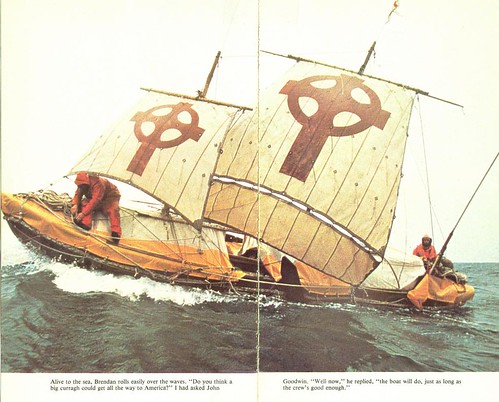
The Brendan: A Curragh that sailed from Ireland to America
SOURCE

He and a crew of sailors were able to sail from Ireland to New Foundland in the craft, which proved, at least in theory, that is was certainly possible for a sea-faring people, as the Irish have always been, to have made the journey. He also came up with some very plausible theories to explain some of the more outlandish details recorded in the Navigatio. The easiest way to cross the Atlantic, is to stay as close as possible to known land masses, which means keeping a somewhat northerly bent to the sailing. It also means that the sailors will come very near to Iceland, which is famous - or infamous, depending on your view of the matter - for its volcanoes. The story of the giant smiths is pretty fantastic, but the descriptions of their fires could just as easily be applied to an erupting volcano. Several times during the Brendan Voyage, Severin and his crew encountered great pods of whales, whose backs broke the surface of the sea, so that the water appeared to be dotted with hundreds of islands, so perhaps the story of landing upon the back of an enormous fish is not so far-fetched as all that. And, they saw icebergs as well, which could very well be taken as pillars of crystal be men who had never seen such things before. Tim Severin wrote a book about the adventure, called simply, The Brendan Voyage which I highly recommend, as it is a great, adventuresome book, which often reads like fiction.

Finally, here is the prayers St. Brendan is to have said before he set out on his voyage:

Shall I abandon, O King of mysteries, the soft comforts of home? Shall I turn my back on my native land, and turn my face towards the sea?


Shall I put myself wholly at your mercy, without silver, without a horse, without fame, without honor? Shall I throw myself wholly upon You, without sword and shield, without food and drink, without a bed to lie on? Shall I say farewell to my beautiful land, placing myself under Your yoke?

Shall I pour out my heart to You, confessing my manifold sins and begging forgiveness, tears streaming down my cheeks? Shall I leave the prints of my knees on the sandy beach, a record of my final prayer in my native land?

Shall I then suffer every kind of wound that the sea can inflict? Shall I take my tiny boat across the wide sparkling ocean? O King of the Glorious Heaven, shall I go of my own choice upon the sea? O Christ, will You help me on the wild waves?

Thursday, December 6, 2012

St. Nicholas Day.


Happy feast day to one and all! If any of you are looking for a reason to eat chocolate, or sugar cookies, or drink hot cider, or perhaps even mulled wine - if you dwell in a cold enough climate - then look no farther. Today is the feast day of St. Nicholas, and all the aforementioned goodies are traditionally partaken of on this day.

I have mentioned before on this blog, that I have a special affection for St. Nicholas. I like saints will a lot of character, and St. Nicholas was certainly that. What I particularly like about him, is that he is a complex, very human saint. I suppose the majority of the saints must be, but it comes through with particular clarity where St. Nicholas is concerned. He showed remarkable holiness from a young age. He endured imprisonment and torture for his Faith during the persecution of Diocletian. He was renowned as a wonder-working in his own lifetime. He performed great acts of kindness and charity to the poor and suffering. He was, in short, a very good, kind, holy man, who was much loved during his life time. However, he was also a staunch defender of truth and the right, who had a very low tolerance for falsehood. He also had a temper, as the story of St. Nicholas at the Council of Nicea shows.

It is a common misconception that that goodness and holiness are rather passive and boring. Nothing could be further from the case, as anyone who has ever tried to be truly good will tell you. There is nothing passive at all in performing good works, in praying when one would rather not, in staying true to a moral code, when it would be much easier to compromise, in putting God and others before yourself.  Goodness, and holiness are intensely active. Like soldiers locked in furious battle, one must give all and stand firm, for if any ground is given, it will lead to a route. The life of St. Nicholas is a perfect example of holiness that was anything but boring. He was a man who was fiercely good, and it was his uncompromising holiness that led to his legendary sympathy and goodness to other.

St. Nicholas is one of the most popular saints in the history of the Church. His feast day is celebrated all over the world. Here is a Slavonic carol in honour of him. (Listen past the English translation at the beginning. It is catchy.)


And here is my all time favourite Santa Claus picture, partly because it us just so darn Christmasy and cosy, but mostly because his study is absolutely packed with all sorts of bric a brac alluding to the life of St. Nicholas, and his role as gift-giver in various cultures around the world. I would love to poke around that room!

Friday, June 8, 2012

Corpus Christi

... Was actually yesterday, so I am a day late on this post. However, I meant to do a post, and was excited about the post I meant to do, so you are getting it today instead. I present to you, The Corpus Christi Carol. Hayley Westenra sings this on her Christmas album, and that is where first I heard it. Obviously, it is not really a Christmas carol, even though the word carol is almost exclusively associated with Christmas these days.


Lulley, lully, lulley, lully,

The faucon hath born my mak away.

He bare hym up, he bare hym down,
He bare hym into an orchard brown.

In that orchard ther was an hall,
That was hanged with purpill and pall.

And in that hall ther was a bede,
Hit was hangid with gold so rede.

And yn that bede ther lythe a knyght,
His wowndes bledyng day and nyght.

By that bedes side ther kneleth a may,
And she wepeth both nyght and day.

And by that bedes side ther stondith a ston,
"Corpus Christi" wretyn theron.

The medieval imagery is intensely allegorical. Most obviously are the symbols of the Wounded Knight, Who is a figure of Christ Crucified, and the weeping may (maiden) who is a figure of His most holy Mother. The barren, brown orchard is open to numerous interpretations: the desolation of the world after the fall of Adam; the emptiness of a soul in sin; death itself, perhaps. The colours too suggest meanings. Purple is the liturgical colour for Lent, and days of penance. Red is used for feasts of martyrs and symbolises blood. Gold is used for high feasts, such as Easter. The word mak here, is an old word for mate, or more specifically, love. The phrase itself is ambiguous, and lends itself to numerous interpretations, but it reminiscent of Mary Magdalene's cry, "They have taken away my Lord; and I do not know where they have laid Him".

The figure of Christ as a knight, or a warrior was very common in medieval allegory. So does he appear in the Old English poem, The Dream of the Rood. In The Vision of Piers Plowman, He appears as a knight, jousting for men's souls. There is a very old poem by William Herbert, Quis est iste qui uenit de Edom contains the line 'what is he, this lordling, that cometh in from the fight?' The imagery is particularly vivid - the Young Hero who dies love - and ties in very beautifully with the Sleeping King/Sleeping Hero myths that abound in mythology.


Tuesday, December 27, 2011

Feast of St. John


Much to my disappointment, though I have assiduously ransacked the internet for the better part of the evening, looking for a hymn, song or carol proper to this feast day, I have turned up very little worth talking about. There is a very fine website dedicated to hymns and carols of Christmas, which contains a list of hymns in honour of St. John, and the lyrics as well. I had hoped for find one of the old, Middle English carols to post - I particularly liked the lyrics to To The Now, Crystys Der Darling - but my ambitions came to not.

Instead, I shall draw your attention to a rather interesting tradition for the Feast of St. John. According to legend, St. John was given a cup of poisoned wine to drink, but he blessed it, and the poison came out of the wine in the shape of a serpent. In memory of this miracle, it used to be the custom for wine to be blessed in honour of St. John. The faithful would serve the blessed wine at the main meal. The wine would be poured into glasses, and the father of the family would raise his glass in toast to the mother, saying, "I drink you the love of St. John." The resonse would be, "I thank you for the love of St. John." Then the mother would give the toast to the oldest child, who would in turn, give it to the next, until the love of St. John had been passed around the table. Sometimes the wine would be prepared before hand according to the following recipe:

St. John's Love (serves 8)

1 quart red wine
3 whole cloves
1/16 teaspoon ground cardamom
2 two-inch cinnamon sticks
1/2 teaspoon ground nutmeg
1/2 cup sugar

Pour the wine into a large saucepan. Add the remaining ingredients. Boil for 5 minutes or so. Serve hot. with the toast "Drink the love of St. John!"

Tuesday, February 1, 2011

St. Brigid of Kildare


Today is the feast day of St. Brigid of Kildare, who, with St. Patrick, is the patron saint of Ireland. I honoured the day in my usual fashion - fashion being a rather significant word here. I decked myself out in a very Irish ensemble, modeled after these lads here. Obviously, I did not present to the world quite so military an appearance, since what I was wearing is properly a kilted skirt, rather than a kilt, and had to be satisfied with a dark green sweater, rather than the fine jackets they are sporting, but the effect, I fancy, is quite nearly as eye-catching.

St. Brigid is one of those saints around whom is woven a tapestry of legends, and one gets a picture of an astonishingly holy woman whose boundless charity and genuine niceness made her very pleasant company indeed. This website is a good place to go for a sample of some of the more common stories told about St. Brigid. I think one of the things I find most endearing about her, though, is her hospitality. Gaelic people tend to have a very high code of hospitality, but she rather outdoes herself in honouring it. Among the many miracles she is said to have performed, there are several in which she turned various liquids into beer to serve to her guests. Indeed, there is a prayer-poem attributed to her, that runs thusly: "I'd like a great lake of beer for the King of kings. I would like to be watching heaven's family drinking it through all eternity." And if that is not enough to endear the hardest of hearts to the Mary of the Gael, I do not know what will!