Showing posts sorted by relevance for query white rose. Sort by date Show all posts

Friday, June 10, 2011

Here's Tae the King, Sir....


Today is White Rose Day, a holiday I had never heard of before yesterday. I owe the discovery of its existence to a small, pencilled notation in an antique Lives of the Saints, that I recently acquired in Scotland, and have been using daily as part of morning prayers. Beside the names of various saints for June 10th - St. Landry, St. Maurinus, St. Gertulius & Co. and, most fittingly, St. Margaret of Scotland - is the neat little addition: White Rose Day. I was intrigued, and the moment I had finished my prayers, I rushed to my handy computer to look it up.

To my delight, I discovered that it a Jacobite holiday. It commemorates the birth of James Francis Edward Stewart, born on this day in 1688. He was the legitimate, staunchly Catholic heir the throne of England, Ireland and Scotland and his birth is generally regarded as the beginning of the Jacobite cause. His father, James II and VII, had converted to Catholicism, and as a result had been forced to abdicate in favour of his Protestant daughter, Mary, and her Dutch husband, William of Orange. It was not an ideal situation, so when James II and VII died, his son was offered the throne by the bitterly Protestant leaders of the country, on condition that he renounce his Faith, but he responded, "Nothing would induce me to abandon my religion, for it is the true one." He did, however, insist upon his right to the kingship, and his supporters raised an army to help him secure it. James in Latin is Jacobus, so his supporters were knows as Jacobites.

They put up a tremendous fight, the Jacobites! Two major uprising they had, one in 1715, led by James himself, and the better known one, in 1746, led by Bonnie Prince Charlie. In between, there were all sorts of intrigues and smaller battles. If a man had a blue cap upon his head, you could be pretty sure that he was a supporter of "the king over the water", that is to say, James Stewart, for he had been forced to flee to France after the Jacobites were put down in 1715. Ladies wore white roses to show their own support. People met in secret to plan for the next move in the battle for their rightful king. The Jacobite cause was finally crushed once and for all, on April 16th, at Culloden in Scotland. Bonnie Prince Charlie and his gallant Scots were defeated, more by treachery and bad judgement, than by any force of arms.

However, the Jacobite tradition carried on. Those who were loyal to the Stewarts continued to drink toasts to the King over the Water, still continued to hope for the restoration of the true kings to the throne. Gradually, a whole, rich tradition of Jacobite songs, poetry and toasts grew up. They continued to wear the white rose - or the white cockade - which had long been the symbol of the Stewarts. And one of their traditions, was the celebration White Rose Day.

So, in commemoration of the day, of the Stewarts, and their Catholic faith, and of their brave supporters the Jacobites, here is a poem, written by Andrew Lang:


WHITE ROSE DAY--JUNE 10, 1688

'Twas a day of faith and flowers,
Of honour that could not die,
Of Hope that counted the hours,
Of sorrowing Loyalty:
And the Blackbird sang in the closes,
The Blackbird piped in the spring,
For the day of the dawn of the Roses,
The dawn of the day of the King!

White roses over the heather,
And down by the Lowland lea,
And far in the faint blue weather,
A white sail guessed on the sea!
But the deep night gathers and closes,
Shall ever a morning bring
The lord of the leal white roses,
The face of the rightful King?


Incidentally, since I like to fancy myself a bit of a Jacobite, I intend to celebrate today by wearing a tartan skirt (luckily made of light-weight fabric, since spring has come upon us) pinning a white rose into my hair, (artificial - a concession to practicality) putting white roses on my table (real ones, of course) and cooking salmon, neeps and tatties for dinner (It being Friday, salmon is as Scottish as it gets). I also intend to have a bit of Scotch whisky, with which I shall offer the standard toast, "Here's tae the King, sir. Ye ken wha I mean, sir. And every honest man wha will dae it again!" and pass my whisky glass over my water glass, lest there be any doubt that I mean the King over the Water.

Sunday, June 10, 2012

White Rose Day


As some of you might remember, I did a post on this holiday last year. I will, of course, be wearing plaid again - it is not quite tartan, but it is very similar to Dress Stewart, though with a bit more black to it, rather than green. I am wearing white roses in my hair, and I bought a little bush of miniature white roses, which are temporarily in a little pot inside, but which I will plant as soon as the Sierra summer arrives properly, and we stop having the occasion freeze at night. There is actually a strain of white roses - quite an old strain too - whose proper Latin title is Alba Maxima, but is also known as the Bonnie Prince Charlie Rose, and the Jacobite rose. If I ever get to be a reliable gardener, I would love to have an Alba Maxima in my garden.

Alba Maxima; Jacobite Rose;
Bonnie Prince Charlie Rose
This year, for celebration, I am going to partake of a bottle of Traquair Jacobite Ale, which I have been saving for today. I bought it at Traquair House in Scotland, where it is brewed. Traquair House is the oldest inhabited house in Scotland, according to their website, but more to the point, for the purpose of this post, it is as staunchly Catholic and Jacobite house. There is a little semi-hidden room in the attic, that was where the priest lived, and a secret stair case, that descends from it, and empties one out the back of the building, where one can scarper off to the woods for cover. There is a lovely little family chapel there - with the original altar, no less, and no sign of any modernisation. Traquair House is particularly interesting because it is still owned by the family, and receives no funds from Historic Scotland for its maintenance. Therefore, there has not been any restoration per se done on it. It is simply kept up, so when you tour it, you get a much better idea of what a historical house was like, than you do at other places.

 Furthermore, I have made a wee small cockade to wear upon my lapel. It was quite easy: two loops of white ribbon, stitched into a cross shape. In the center is a wee pin featuring the rampant lion. The lion is an old symbol for Scotland, and the red lion on a golden field was long used in the Royal Standard, so it seemed particularly suitable to wear today.


I shall finish by posting quite an old video of the Corries singing The White Cockade. It is charming:


Wednesday, November 30, 2011

November 30th


Well, golly! To my amazement, I did it. I managed to write better than 50,000 words this month - 50,377, to be exact - and so have fulfilled the challenge of National Novel Writing Month. The thing I have created cannot properly be called a novel. That is far too grandiose a title. What I actually have is a rough draft - and exceedingly rough draft, of something that will potentially be a novel someday. (Soon hopefully.) Still, this is something of a mile-stone for me, as I actually have all the key point of the novel written out, with a proper beginning, middle and end. It is the closest I have ever come to actually writing one of those books I am always threatening to write, and as I result, I am feeling so pleased with myself that I am going to indulge in a little bit of blowing my own horn. I present to you all, my award:


On a totally unrelated note, today is the feast day of St. Andrew, who is the patron saint of Scotland. Being the ardent Scotophile that I am, I celebrated the day, at least in a small way. I am the owner of a very fine Royal Scots cap badge:


which I pinned in my hair, along with a white rose, which I generally break out on days of Scottish national import, since the white rose - along with the thistle - is the national flower of Scotland. I wore my little pin with the American flag on one side, and the Scottish flag on the other. Oddly enough, though St. Andrew is the patron saint of Scotland and has been since the Battle of Bannockburn, and though the Scottish flag is a composed of a blue field, with a white, St. Andrew's cross emblazoned on it, St. Andrew's day is not really a big deal in Scotland. No doubt we have the Covanenters and their legacy to thank for that, and it is rather a shame. I wanted to post a video or a music clip in praise of St. Andrew, but decent music in honour of this great saint and apostle is very hard to find. There is a polyphonic Gregorian chant in his honour here for those who are interested.

Thursday, June 30, 2011

It Is A Sign, I Tell You....


.... I am not quite sure what it is a sign of, but it is definately a sign. The bouquet of white roses I bought to celebrate White Rose Day are still blooming. I do not remember the last time I had cut flowers last so long as this. Oh, I will grant you that over the last couple days they have gotten wee bit past their prime, but only the least, tiny bit. They are still remarkably fine looking. Three weeks.... not bad at all.... It bears repeating: It is a sign, I tell you!

Wednesday, July 31, 2013

Border Tart


Among the things I did over the last couple months which I meant to blog about, but never got around to, was the celebration I had for White Rose Day. I bought white roses for my table, broke my fast on tea and scones, with clotted cream. (The clotted cream was a huge treat. I had only ever eaten it in Scotland, because I could not find it here. But it turned up on the shelves of the local Grocery Outlet, and I pounced on it with glee and jubilation.) For dinner, I cooked up a bit of haggis, neeps, tatties, and a wee bit of steak in case the company I invited (in this case, my brother and several sisters.) did not enjoy the great chieftain o' the puddin' race. Fortunately, most of them like it quite well, and those who were not crazy about it, did not dislike it, and so it was eaten entirely. We finished with the customary toast to the King Over the Water - a neat little ceremony. One simply raises one's glass, says, "To the King!" and passes the glass over a cup of water before taking a sip from it. It was a lovely day.


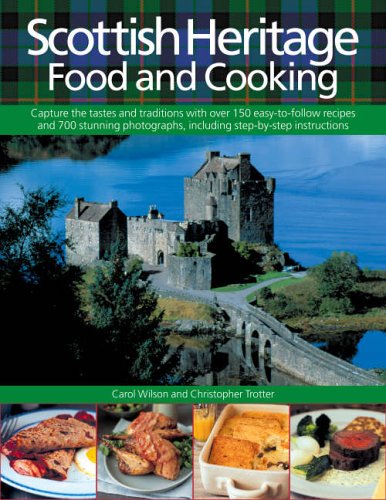
For dessert, there was a border tart. I got the recipe out of a really beautiful cookbook which I received a couple years back, for Christmas. Scottish Heritage Food and Cooking it is called, a beautiful book, full of pictures. Some of the recipes are a bit hoity-toity (and one calls for avocado which is most emphatically not Scottish.) Still, there are a sufficient number of quite manageable dishes, so I have enjoyed trying my hand at the occasional recipe. It is this book right here:


THE RECIPE:


The Auld Alliance crust is probably the best and easiest pie crust recipe I have ever come across: Cream together 10 tbsp butter and 1/4 cup sugar. Add 2 cups flour and 1 egg. Mix until just combined - do not over-work the dough. Be lazy with it! Chill dough until ready to use. It is light, flaky, and very tasty. I shall never use another pie crust recipe again. 

I did make a few changes to the filling. I could not find currents anywhere. Perhaps I am looking in all the wrong places. Perhaps there just is not a great demand for currants in my neck of the woods. I used raisin instead, and it tasted just dandy. Even the sister who does not like raisin agreed that they are good in this recipe. And, for some reason, I had an excess of almonds when I set out a-baking, so there were almonds as well as walnuts in the tart. 

Here I am, setting the tart out to cool. Yes, I really am wearing an apron that looks like a kilt with a sporran and Prince Charlie Jacket. It was the gift of a cousin who knows me well. The sporran is actually a pocket.


And here we have the finished tart, in all its glory. It tasted as good as it looks, and it is so very easy to make:


As a side note: this is also a very versatile recipe. You may use just about any sort of nut and dried fruit mixture that strikes your fancy, and it still turns out quite nicely. I know. I've been experimenting. It is wonderful when it is still warm from the oven, and it is also very nice the next day, taken cold. It is the ideal dish to take to a dinner or a pot luck, because it looks like farm more work than it is :-)


Thursday, August 4, 2011

Our Lady of the Snows


Today is a rather unique feast day in honour of our Lady - Our Lady of the Snows. It is an odd title, and it is even odder to be celebrating such a feast day during the high summer days of August. There is a very good reason for it, though, for it commemorates a miraculous fall of snow, which marked the location upon which Santa Maria Maggiore, one of the principle churches in Rome, was to be built. The legend of our Lady of the Snows runs like this: In the 4th century, during the reign of Pope Liberius, a holy man named John and his wife, being childless, made a vow to leave their earthly possessions to our Lady, and prayed that she would inspire them how best to dispose of their wealth in her honour. In answer to their prayer, she appeared to the holy couple, in a dream, and to the Holy Father as well, requesting that they build a church in her name upon the Esquiline Hill, and that she would give them a sign to show where the exact location was to be. The following morning, they all went in procession to the Esquiline Hill, to discover that a heavy snow had fallen during the night, to mark the location of Our Lady's church.

The Basilica of Santa Maria Maggiore is one of the oldest churches in the world to be dedicated to our Lady. It contains two very special relics, relating to her motherhood: a very ancient painting of the Madonna and Child, which is attributed to St. Luke; and the Crib of our Lord. It is the possession of that Crib that gives the Basilica its secondary title of Santa Maria del Presepe - St. Mary of the Crib.

On the feast of Our Lady of the Snows each year, a shower of white rose petals are dropped from the roof during Mass, to commemorate the miraculous snow that marked the church's foundation. Here is a clip of it:


Friday, September 28, 2012

And Another Doodle


This is for Gina, who is very complimentary about my sketches, and also for Bella, who is tired of my post on the Battle of the Bridge of Stirling - a wee 18th century Highland Jacobite, complete with a white rose, to show where her allegiance lies:


Highlanders of this period wore the tartan as part of their regular clothing. Men generally wore a feile mor, or great plaid, which was the precursor of the modern kilt. A feile mor would be pleated, (or kilted to use the old word) and belted at the waist, with a long bit leftover, which could be used for a cloak, but which was generally pinned at the shoulder to keep it out of the way. Women did not wear a feile mor. Nor did they wear those dresses consisting of a lace-up bodice, and a full plaid skirt, which one often finds for sale in Renaissance clothing catalogues. No, what Highland women had was an arisaid, a great cloak of tartan material, worn over their dresses, often pinned at the neck, and belted at the waist, much as this young lady is wearing hers. Unmarried ladies also generally wore a little band of ribbons in their hair, and if you look closely, you can see that I put that in as well... Yes, I am aware of the technical flaws in the sketch, but I am still rather pleased with how it turned out.

Sunday, May 30, 2010

Joyce Kilmer


Memorial Day

"Dulce et decorum est"

The bugle echoes shrill and sweet,
But not of war it sings to-day.
The road is rhythmic with the feet
Of men-at-arms who come to pray.
The roses blossom white and red
On tombs where weary soldiers lie;
Flags wave above the honored dead
And martial music cleaves the sky.
Above their wreath-strewn graves we kneel,
They kept the faith and fought the fight.
Through flying lead and crimson steel
They plunged for Freedom and the Right.

May we, their grateful children, learn
Their strength, who lie beneath the sod,
Who went through fire and death to earn
At last the accolade of God.
In shining rank on rank arrayed
They march, the legions of the Lord;
He is their Captain unafraid,
The Prince of Peace . . . Who brought a sword.


At the time of his death in France during WWI, Joyce Kilmer was one of America's up and coming young talents. He wasn't exactly a household name, but his poems were well known, and well loved. Since then, his reputation has been largely overshadowed by the rest of the war poets, and he is largely - and I think, unjustly - neglected in modern collection of poetry, especially war poetry. If he is remembered at all, it is generally for his poem, Trees, which is rather unfortunate.


"Trees" is a very nice little poem. It has some lovely rhyming sequences, evocative imagery, and the typical Kilmer twist at the end, that praises God in creation, and expresses the poet's own humility. For all that, is not a very remarkable work, nor it is particularly expressive of the type of man Joyce Kilmer was. He was not a sentimentalist, except in the modern misunderstanding of the word, which confuses sentiment with idealism. He was a true poet, with a healthy touch of genuine Romanticism. He saw beauty everywhere he looked, and mystery and adventure. He expected life to be a challenge, and he met difficulties head-on, and with characteristic gusto. If his poems, particularly is earliest ones, are full of a child-like wonder and simplicity, it is not because he had not face life in all its grim reality, but because he could see beyond that reality in to the realm of Absolutes and Eternity.


Joyce Kilmer was one of those rare individuals who are truly good, but make goodness seem, not only intensely attractive, but also as the only way for a man of any worth to be. He lived enthusiastically. He loved words. He was employed to work on the Funk and Wagnalls dictionary, where his job "was to define ordinary words assigned to him at five cents for each word defined. This was a job at which one would ordinarily earn ten to twelve dollars a week, but Kilmer attacked the task with such vigor and speed that it was soon thought wisest to put him on a regular salary" He loved food, and used to claim that eating a hearty meal was compensation for lack of sleep. He seems to have been utterly imperturbable. Once, when he was in a hurry, he was knocked down by a train, and dragged for a little distance. He survived with only a few cracked ribs to show for it, and seemed to regard the whole thing as a rather comic experience, that would teach him to be more careful in the future. He was much in demand as a public speaker, but seldom prepared notes for his speeches. Sometimes, he would only decide on the topic of his speech over lunch, half an hour before he was scheduled to appear. For all that, he was a remarkably good public speaker, and enjoyed it thoroughly.


Perhaps the single greatest moment in his life was when he and his wife, Aline, were received into the Catholic Church. Their daughter, Rose, had been stricken with infantile paralysis shortly after her birth, and in their distress, they turned to God. In a letter to his good friend, Fr. James Daly, he wrote, "I believed in the Catholic position, the Catholic view of ethics and aesthetics, for a long time. But I wanted something not intellectual, some conviction not mental - in fact I wanted Faith.... When faith did come, it came, I think, by way of my little paralyzed daughter. Her lifeless hands led me; I think her tiny feet know beautiful paths." From that time on, Kilmer lived the Faith to the fullest. He took the Catholicism as naturally as breathing. He developed great devotion to the saints: St. Nicholas, on whose feast day he was born, the Irish saints, Patrick and Bridgit, no doubt because of his affinity will all things Irish, the warrior saint, Michael, and Joan of Arc, because his spiritual out look was very much that of a soldier. His over-riding desire was to live in such a way as to be worthy of that gift of Faith, that he had prayed so hard for, and to give glory to God in the best way he knew: by his writing.


He was a prolific writer, regularly turning out criticism, plays, essays, and short stories. His wartime story Holy Ireland is one of the finest things he ever wrote. But it is for his poems that he is best remembered. His early poems were very pleasant reading, it not particularly earth shattering. They all show, however, Kilmer's distinctive ability to find inspiration in almost everything, from a commuter train to an abandoned house. His best poems were written after his conversion, and the best of all were the ones he wrote as a soldier in France


He volunteered for service as soon as the United States declared war. He liked to boast that he was "half Irish" so it was the predominantly Irish "Fighting 69th" that he joined. He rose to the rank of Sargent, and could have got a commission, but refused to, because he would rather have been a Sargent of the 69th than an officer in any other regiment. He wrote to Aline that he intended to write a book about the experience, which he decided to call, "Here and There With the Fighting Sixty-Ninth". He had great ambitions for the book, declaring that it would be "a most charming book... the sort of book I'd greatly like to read.... no glib tale, no newspaper man's work - but with God's help, a work of art." He never did get to write that book, but he wrote several extremely fine poems, for which he ought to have been remembered: The Rouge Bouquet, The Peacemaker, and The Prayer of a Soldier in France. They are the work of an accomplished poet, as well as a deeply spiritually patriot.


Joyce Kilmer was killed in action on July 30, 1918, by a sniper's bullet, while on a reconnaissance mission in No Man's Land. He is buried in France, and was posthumously awarded the Croix de Guerre by the French Republic.


Peace to each manly soul that sleepeth;
Rest to each faithful eye that weepeth..


.~Thomas Moore


Requiem æternam dona eis, DomineRequiem æternam dona eis, Domine


Happy Memorial Day to all of you.

Monday, November 4, 2013

Middle-Challenge, Day Four


Favourite Scene

Oh dear. I am going to do two favourite scenes here. The first is from the book The Return of the King, with Faramir and Eowyn:


Seven days,' said Faramir. 'But think not ill of me, if I say to you: they have brought me both a joy and a pain that I never thought to know. Joy to see you; but pain, because now the fear and doubt of this evil time are grown dark indeed. Eowyn, I would not have this world end now, or lose so soon what I have found.' 

'Lose what you have found, lord?' she answered; but she looked at him gravely and her eyes were kind. 'I know not what in these days you have found that you could lose. But come, my friend, let us not speak of it! Let us not speak at all! I stand upon some dreadful brink, and it is utterly dark in the abyss before my feet, but whether there is any light behind me I cannot tell. For I cannot turn yet. I wait for some stroke of doom.'

'It reminds me of Numenor,' said Faramir, and wondered to hear himself speak.

'Of Numenor?' said Eowyn.
'Yes,' said Faramir, 'of the land of Westernesse that foundered, and of the great dark wave climbing over the green lands and above the hills, and coming on, darkness unescapable. I often dream of it.'

'Then you think that the Darkness is coming?' said Eowyn. 'Darkness Unescapable?' And suddenly she drew close to him.

'No,' said Faramir, looking at her face. 'It was but a picture in the mind. I do not know what is happening. The reason of my waking mind tells me that great evil has befallen and we stand at the end of days. But my heart says nay; and all my limbs are light, and a hope and joy are come to me that no reason can deny. Eowyn, Eowyn, White Lady of Rohan, in this hour I do not believe that any darkness will endure!' And he stooped and kissed her brow.


And so they stood on the walls of the City of Gondor, and a great wind rose and blew, and their hair, raven and golden, streamed out mingling in the air.

Then Faramir came and sought her, and once more they stood on the walls together; and he said to her: 'Eowyn, why do you tarry here, and do not go to the rejoicing in Cormallen beyond Cair Andros, where your brother awaits you?'


And she said: 'Do you not know?'

But he answered: 'Two reasons there may be, but which is true, I do not know.'

And she said: 'I do not wish to play at riddles. Speak plainer!'

'Then if you will have it so, lady,' he said: 'You do not go, because only your brother called for you, and to look on the Lord Aragorn, Elendil's heir, in his triumph would now bring you no joy. Or because I do not go, and you desire still to be near me. And maybe for both these reasons, and you yourself cannot choose between them. Eowyn, do you not love me, or will you not?'

'I wished to be loved by another,' she answered. 'But I desire no man's pity.'

'That I know,' he said. 'You desired to have the love of the Lord Aragorn. Because he was high and puissant, and you wished to have renown and glory and to be lifted far above the mean things that crawl on the earth. And as a great captain may to a young soldier he seemed to you admirable. For so he is, a lord among men, the greatest that now is. But when he gave you only understanding and pity, then you desired to have nothing, unless a brave death in battle. Look at me, Eowyn!'
And Eowyn looked at Faramir long and steadily; and Faramir said: 'Do not scorn pity that is the gift of a gentle heart, Eowyn! But I do not offer you my pity. For you are a lady high and valiant and have yourself won renown that shall not be forgotten; and you are a lady beautiful, I deem, beyond even the words of the Elven-tongue to tell. And I love you. Once I pitied your sorrow. But now, were you sorrowless, without fear or any lack, were you the blissful Queen of Gondor, still I would love you. Eowyn, do you not love me?'

Then the heart of Eowyn changed, or else at last she understood it. And suddenly her winter passed, and the sun shone on her. 

'I stand in Minas Anor, the Tower of the Sun,' she said; 'and behold! the Shadow has departed! I will be a shieldmaiden no longer, nor vie with the great Riders, nor take joy only in the songs of slaying. I will be a healer, and love all things that grow and are not barren.' And again she looked at Faramir.


'Then must I leave my own people, man of Gondor?' she said. 'And would you have you proud folk say to you: "There goes a lord who tamed a wild shieldmaiden of the North! Was there no woman of the race of Numenor to choose?" '

'I would,' said Faramir. And he took her in his arms and kissed her under the sunlit sky, and he cared not that they stood high upon the walls in the sight of many. And many indeed saw them and the light that shone about them as they came down from the walls and went hand in hand to the Houses of Healing.

And to the Warden of the Houses Faramir said: 'Here is the Lady Eowyn of Rohan, and now she is healed.'

It is, in my opinion, one of the most beautiful scene in the whole book - two people who hand lost much, and suffered much, but their sufferings turned into joy at their meeting. I normally hate kissing scenes in movies, but I will admit that I was disappointed that even in the Extended Edition of The Return of the King, Faramir and Eowyn did not kiss in the sight of many.

One of my favourite scenes in the movies comes from The Return of the King as well. It is this one here:


Even if I have managed to be stoic throughout the film, this particular scene does me in. I will cry over that scene, every single time. Not sad tears, mind you, just... tears for the sheer beauty of it.

If you are interested in finding out more about the Middle Earth Challenge, click here.

Monday, August 4, 2014

National Chocolate Chip Day


I shall start this post with a Public Service Announcement.  According to this site here, today is - you guessed it - National Chocolate Chip Day. I will be back in a moment. I feel a sudden, wild urge to celebrate this auspicious occasion....

Ah... Much better....

And now, fortified with chocolate chips (which we all know are really tiny kisses of the best variety) I am tackling the issue of accumulated tags. There are three, and I have put some thought into how to obligingly do the tags, without running into tedious lists of 33 things which my readers might not know about me. Mind! I am fully aware how endlessly fascinating I am, but even I am obliged to admit that 33 random facts might be overly taxing to all but the most obsessive reader - which, I am thankful to say - none of you are. This is a compliment. You are all lovely, and attentive, but not alarming. I appreciate that.

So, why have I not been writing on this blog? Well, I have been feeling rather crafty, and not author-ish. Here are eleven pictures to show just how occupied I have been:

1.) I have been making these origami poppies (with apologies for the quality and the ridiculously wide white frames):


2.) This paper rose, from an old piece of piping sheet music, of which I possessed  newer version:


3.) This miniature, hand-stitched Eeyore:

4.) This curious little robot, made from a tooth brush, with a battery and a vibrator. When you twist the wires in the back together, it skitters and twirls all over the place:


5.) This check book cover, made from an old tea box, and duct tape:


6.) These beads:


7.) Which, in turn, were made from the roses and stock in these flowers (once they were past their prime, and with a dash of cocoa powder thrown in to darken them), which were a gift- the first flowers I have ever recieved, and of which I was ridiculously fond:


8.) This rosary, made of the afore mentioned beads.


9.) These books:


10.) This picture, which was originally supposed to be posted on Memorial Day, but obviosly, never made it:


11.) This pie, based of a recipe for Cinnamon Custard Pie, but with chocolate chips in it, because of the day:


It has been many a long year since I have felt this crafty. I am enjoying it rather excessively. Indeed, I am fancying myself something of a craftsman these days. I want to make ALL THE THINGS! 


 (Oops, I have to work... make SOME OF THE THINGS... and finish the rest when I get home :-)

Yes, I am just a trifle insane. Whatever tipped you off?

So now, on to the questions part of this tag. I shall do Kat's questions first.

1.)  If you could choose to be a bug, what kind would you be?
          This althetic little creatures looks nice and harmless:

Bugs Bunny Hd Listening To Music Bug 194506 1920×1080

 2.)  You are given a choice between pizza and chocolate.  What do you choose?
       Chocolate, of course.

3.)  What does Panama make you think of?
       Hats :-) .....and origami cranes

4.)  Have you ever been so obsessed with a TV show you literally can't think of anything else for days?  Weeks, even?  If so, which TV show(s) are you obsessed with at the mo'?
       Yes, but at the moment, I am blessedly free of adictive viewing material.

5.)  Do you prefer pens or pencils when writing?
       Pens. Fountain Pens. This Pen, to be exact:

http://dirck.delint.ca/beta/wp-content/uploads/2011/09/Sheaffer-0202.jpg
Sheaffer Tuckaway
6.)  If you could have one superpower talent, what would it be?
      Invisibility.... or the ability to create weather.

7.)  Do you visualize yourself as an archer or a ninja?
      Archer.

8.)  Quick!  Off the top of your head, what's the ONE THING you can't live without?
      Faith.

9.)  You're on the run.  Would you rather have a.) a hairbrush, or b.) a toothbrush?
      Hairbrush, because it is easier to stay incognito if one has a tidy appearance.

10.)  Are you a summer or winter person?  Why?
        Winter. Because I have an extremely low tolerance for heat. And like my winter clothes, and Christmas, and brewing wassail. And I even like driving in the snow.

11.)  Do you unashamedly watch cartoons and cry over them?  (If yes, high five, sista!)
        Yes. Up anyone? That Scene in Tangled? It is a little embarassing though.

And now, Bella's questions, but since she tagged me twice, I am not going to answer all 22 of them. I am doing every other one from each tag, which will make all concerned quite happy, I'm sure:

1.) Do you consider yourself a Nerd or a Geek?
    I am a Nerd and I'm not ashamed to say it.

2.) Have you read The Ascendance Trilogy?
     Not yet.

3.) What is the first thing you think when you see salt?
      Quotes mostly. "If a salt looseth its flavour, wherewith shall it be salted?" or puns, "We're taking this meal with a grain of salt, hardy har har."

4.) Are you a Tolkien Purist?
     YES! Our family does not discuss the film version of The Two Towers when I'm around. 

5.) Range Rover or Land Rover?
     Landie, because they're a bit smaller, and I prefer smaller cars.

6.) What book are you reading RIGHT NOW, and is it good?
     I am not reading anything. I'm having trouble finding something decent to read.

7.) Do you like Raisin cookies?
     Yes, actually. 

8.) Have you ever had Vegan Chocolate?
     It sticks in my mind that I attempted to eat some vegan chocolate chips once, and didn't particularly enjoy the experience.

9.) What does it mean to have cat-like tread?
      Behold:

10.) Would you go shopping with me dressed as your favorite Avenger?
       Do you mean that you are going to dress up as my favourite Avenger, or that I'd have to?

11.) Do you ever wear a robe? 
       Well... no. I mostly wear shawls... that is, when it is nice enough weather to compell the additional layer of clothing. No shawls during the Dog Days.

Right. So. That's done. I am caught up.  I feel good about that - like I have accomplished something. It is novel. Hopefully, the next post will be a bit of writing. I have ambitious story ideas brewing, and have actually started getting some if it down. If the chapter I am working in turns out well, I might post it. I am saying this aloud and in public as a means of getting a move on here.  

Thursday, May 30, 2013

In Which I Am Bold


Today is the feast day of St. Joan of Arc. I have a special fondness for St. Joan. She was a great influence on me during my teenage years. I liked her. She was the sort of girl with whom one could easily be friends. She was devout, but passionate with it. She loved beautiful things, which gave here just a wee, charming touch of vanity. She was brought up simply, and was well-contented. If she had been left to her own devices, she would have remained in obscurity, a shepherd-girl, who loved her home and her family, and enjoyed her life amongst them. Yet, when God literally spoke to her, through His angels and saints, and revealed what His will was for her, she had the moral courage to walk away from everything she loved, and serve Him as He wanted to be served. She became her country's great hero, an almost legendary figure, but she remained herself to the end - Joan the Maid, who would have gone home to her mother, if she could. I wanted very much to be just like her. Indeed, my goal in life is still very much the same: to be contented in the life God has given me at the moment, but, if at some point, He gives me another way of life in which to serve Him better, to show the same sort of courage as St. Joan and follow Him.

I think I have mentioned before on this blog, that there were Scottish soldiers fighting in the army of Joan of Arc. One of the great number of books I intend to write, but have not gotten around to actually working on yet, is a work of historical fiction, from the viewpoint of one of those Scots, possibly a piper. (Yes, there were pipers too. Once the French had lifted the Siege of Orleans, St. Joan marched into the city, with a company of pipers.) Several years ago, however, I did write a short story as a sort of back-history to the book I intend to write. It takes place sometime after the Scots had suffered a defeat at a Rouvray, in a skirmish known as the Battle of the Herring. And after much debate within myself, and with a certain measure of trepidation, I have decided to post it here:

*********************

Hughie Stewart was drinking, though he no longer knew what, nor did he care, so long as it was strong. He had started with just a little of the rough, red wine common to that area of France, but that was weeks ago and no matter how much of it he took, it had not the strength to keep the faces of his dead comrades from coming to him in his sleep. Whatever it was he had now was a harsh, strong drink that burned his throat and belly. It was vile, and made him long for the pure uisce beatha of his own native Scotland, but it served his purpose. He drank until forgetfulness came, until the world around him blurred and spun, and sleep was deep and black and dreamless.


Occasionally during those weeks, he would come to himself, lying in some forgotten corner of a dirty inn, or in a back street, with a sickness upon him, and a head shattered by drink. Then he would look at himself with a clear, sardonic eye, and see himself plainly - and the sort of man he was rapidly becoming. At such times he would be bitterly ashamed of himself, and resolve to break from this life, but grief was more bitter still. In those moments of clarity, he would see again the faces of his clansmen lying broken by the English assault on the field of Rouvray: his older brother Dauid, who had promised their mother to keep an eye on Hugh; his cousins, Robert and Angus; Roger, his friend from boyhood, who had left a wife; brave John Stewart who had led them… He was but a very young man, and now he was alone in a foreign land, wounded in both body and spirit. He drank alone. There was an intensity in his silence that prevented all but the most gregarious from approaching him.

He could never remember just how the fight started. There were three or four Frenchmen, that much he knew. They had been loud and crowded him too closely. He remembered that they had spoken to him, and he had stirred himself to answer. He was far gone in his drink, and the world was very distant. He heard the laughter at his response, but did not know the cause of it. He only wished for them to go and leave him in peace, but they would not. They sat down beside him, pulling their chairs up close, their faces too near and terrible to his blurred vision. He tried to pull away from them, but one of them had an arm around his shoulder. They were speaking and his muddled mind was trying desperately to make sense of what they were saying. There was something about a maid, something else about a battle and herring, and the Scots, and there was mockery in the tone.

Then he was on his feet and in a rage. He remembered with a painful clarity the sound of his chair falling back with a clap upon the floor. The one who had just spoken was looking at him with a lazy, arrogant smile, and Hugh hit him full in the face with all his strength. The man went down without a sound, and his companions were on Hugh in an instant. Had he been less gone in drink, or had a single man to stand with him, he could have held them off, for he was a fierce and canny fighter. But he was ill and drunk and alone. The wound he had taken at Rouvray was barely healed and the arm he had taken it in sore and slow. The Frenchmen took him out into the street and beat him for their companion; beat him, though he fought to the last, until he was bruised and bloody and fell unconscious in the gutter.

He came to himself some little while later, slowly, and in great pain. His head hurt so that he could scarcely bear to lift it from the ground. His very eyes ached. The wound in his shoulder had reopened and he could not move the arm. He had a hundred aches and bruises. For a time he could do no more than lay still, but gradually the pain receded, and he was able to sit up, though his whole body protested, and his head hung down upon his chest. He felt sick, broken and utterly wretched. He thought of his clansmen on Rouvray, and buried his face in his hands.

When he at last felt well enough to stand, he returned again to the inn, but only long enough to retrieve his gear. The innkeeper was a kindly man, with a son nearly the age of Hugh. He returned the things, shaking his head slightly, and said, “You should not drink so much, mon ami.” Hugh looked down at the sheathed sword in his hand, then at the innkeeper’s worried frown. “I will not do so again,” he vowed, and went out.

Nor did he, but neither did he eat. He wandered to streets blindly, though now it was not the ghosts of Rouvray he fled, but those of himself, and the man he had become those last weeks. Sometimes he came to a church, and at such times he would go in, and kneel in the dark shadows at the very back. He could not pray, his mind and soul were too disquieted for that, but he knelt before the hidden God, and showed Him his sorrow, for a small space of time before that sorrow drove him to wandering again.

*********************

He did not see the line of men on horseback until they were almost upon him. The foremost rider nearly rode him down before he was able to draw his beast up short and halt his men. The man uttered an oath, and a surprisingly high, light voice called, “Baudicourt!” in rebuke. The man recollected himself, and apologized hastily, almost sheepishly. There was a laugh, and the light voice went on, “What is it you have found there, mon capitaine?”

Hugh had leapt backward at the last moment, when the noise of their riding had finally burst upon his ears. He had fallen, weak from hunger, and lay there, spent and aching from head to foot. He stared up at the riders, nearly blinded from the glare of torchlight. There was a stir amongst them and a babble of voices. A figure, somewhat smaller than the others, broke from the line and came riding forward. He saw the red light glancing off armour, the dark shadow of cape billowing in a stir of wind, then a small, pleasant face looked down at him, the eyes bright, though there were shadows beneath them. "En nom Dieu!" the light voice exclaimed.

He stared helplessly back, astonished even through his pain, that it was a young woman who was looking down at him. He remembered, distantly, the night at an inn, when he had hit a Frenchman, and been unable to fight off that man’s friends. They had spoken of something like this, had they not? A maid, he seemed to remember one of them saying, who was coming to raise the siege of Orleans. A maid who was come in answer to a prophecy, who gave prophecy herself, and those prophecies came true. He had not paid attention to those men then. He had been consumed with his own grief, and had begged them to be gone, but they would not. Now it seemed he was looking into the face of their maid as he lay in the street. He felt the blood come to his face, and got to his feet, slowly, like an old, old man, but he was a soldier and of noble blood, so when he stood at last, he looked it.

Baudicourt was frowning at Hugh. He had been inclined at first to dismiss the man in the street as a beggar, or a common drunk, but now he stood straight and tall before him, with an odd dignity that was disconcerting. “Speak sir,” he said, abruptly, but not discourteously, “What is your name?”

“Hugh Stewart, sir, of Scotland.”

Baudicourt’s men began to speak at once, for the valour of the Scottish soldiers was well know, and the defeat of them at Rouvray had been the bitter blow that led to the siege of Orleans. “Écossais, Écossais” they said, and repeated his name, for it was John Stewart who had led the Scots.

“Well then, Hugh Stewart, of Scotland, why do you wander about the street, obstructing my horses?”

Baudicourt still glowered down on him, but it was not to Baudicourt that Hugh made answer. It was to the maid at his side, who smiled sympathy at him.

“I have lost my comrades, and…” he paused, unable to explain to these fighting men, what he had not been able to explain even to himself, “I have lost my way…” he finished softly, looking away from the goodness he saw in the face of the maid. He stared at his feet.

He heard the murmur of voices again, then the maid had urged her horse forward, till she stood directly before Hugh, and he had no choice but to look up at her. She had a good face, though she was not beautiful. There was a great purity and holiness about her, that would have been daunting, but for the frank humour that he had often observed in the faces of fighting men. She was smiling, a sad little smile, and she touched his shoulder lightly.

“It is not so hard to find yourself, mon ami .” she said softly, “The good God is kind to soldiers. How long has it been since you have eaten?”

Hugh shook his head. He could not remember when he had last taken food or drink.

“Well, Hugh Stewart of Scotland,” the bit of laughter that was seldom far from her was back in her voice now, “You cannot find yourself if you become a fantôme!” She produced a coin from the wallet hung from her waist, and gave it to him, despite his protests, “ Monsieur Stewart,” she said very firmly, “You must eat! And then en nom Dieu find a priest, yes? It will do you much good”

Hugh hung his head again. Her goodness had unmanned him, and he could not speak for a moment. “If it please the maid,” he answered at last, “I shall try.”

She shook her dark, cropped head, “Non, non, monsieur, not to please me, but to please the good God.” She smiled at him again, “Do not forget: food first, Hugh Stewart! France has need of good soldiers.”

Then she gave signal to Baudicourt, and the men rode on. Hugh watched them go with out a word, the coin she had given him clutched tightly in his fist. The maid had turned once and waved to him, and he had raised his arm in return. It was the arm that had taken the wound, the one she had touched when she had spoken to him. The pain in it was gone, and the pain in his heart seemed less burdensome. He allowed himself to think of her face once more, and grinned, a slow, unaccustomed grin. If the maid really intended to raise the siege of Orleans, he had no doubt she would. What a doughty companion she must be.

He did not immediately eat as she had suggested. He found a church first and took his customary place at the back. He still could not pray, at least, not as he wished, but he looked long and fervently at the tabernacle where his Lord lay hidden. He did not know how long he knelt there, for he forgot himself during that space of time. Then he came to himself, and looked at the little coin still clenched in his fist.

He took meat at the next inn he came to; meat only, and a bit of bread. Then he took to wandering again, and it was many days before could bear to look for a priest. It requires courage to speak of sins one wants to leave hidden, even into the ear of a good God. But at last the priest came to him, as he knelt in the shadows of a wayside church – an old priest, wise in God. Hugh allowed the priest to lead him out into the sun, and when the old man asked what it was that troubled him, Hugh told him, hesitating a good deal over the story. He wanted to be honest, but was shamed by the telling. The priest listened, saying no word until it was over, and then, there was no rebuke. He simply said, “ah, poor man,” and comforted him as a father. The next day, Hugh returned to him, and was properly shriven. Then he knelt for a long time before the altar, praying not in words, but from his heart, showing the good God the sorrows he still bore, and thankful for the comfort He had been given.

*********************

The army of the Maid of France lay camped before the River Loire, near the besieged town of Orleans. Hugh made his way there, neatly uniformed and girt with his sword. The guards stopped him at the edge of the camp, but he surrendered his sword to them with his name, and asked to see the Maid, or, failing that, Baudicourt. A soldier was sent with the message and returned a short time later with a grin on his face. He spoke to the guards first, before delivering his message.

“She’s arguing battle strategy with le capitaine. By my staff! There is a woman can argue for you! You think, mon ami, that you have won the argument, and then she says, ‘in the name of God, it shall be done this way!” and all at once you see that it must be so.”

The soldier nodded at Hugh, returning the sword to him. “She says she’ll see you, if you be the same Hugh Stewart of Scotland she remembers.” He laughed at the startled expression on Hugh’s face, and led the way across the camp to tent, where the maid sat before a table strewn with maps. Baudicourt was beside her, looking irritated and amused, as he often did in the company of Jehanne of Domremey.

The Maid saw Hugh as he entered. She rose, and a bar of sunlight from the open tent-flap fell upon her white armour, and threw a halo of light about her face. She held her hands out to Hugh, and he went to her and knelt before her, his hands upon the hilt of his sword, his head bowed.

“As it please God, Hugh Stewart of Scotland pledges his sword to the cause of France and the Maid.”

She smiled the frank, boyish smile of hers, and she touched him lightly.

“Then, en nom Dieu, I am glad to have you.”